










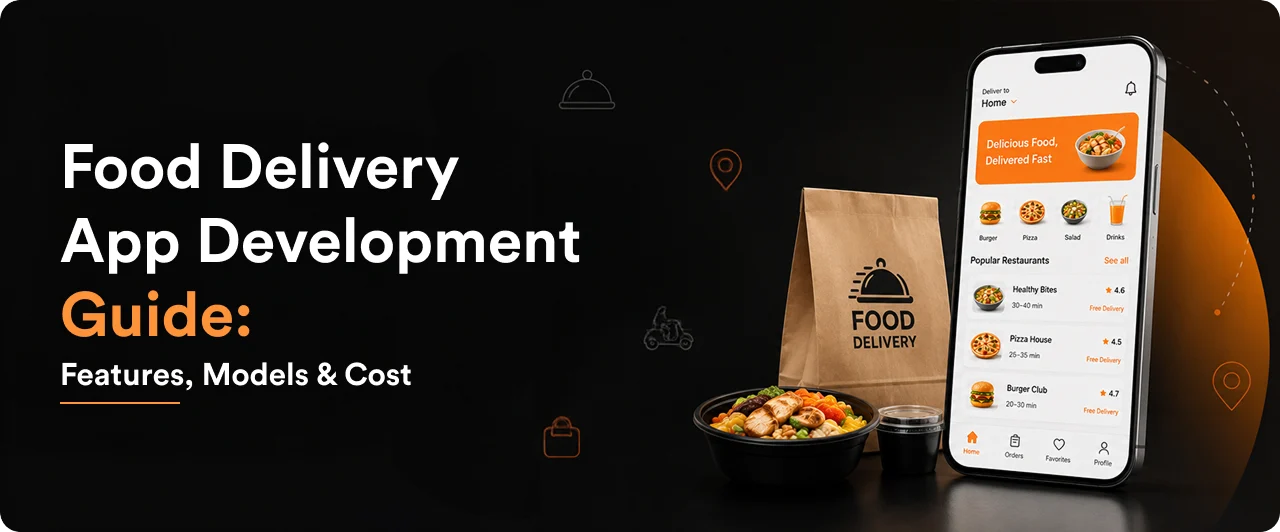
Customers are regularly scrolling through food delivery apps. Apps offer exceptional convenience and time saving. Customers are now used to that. If your restaurant isn't in that scroll, you're losing orders to someone who is. A good food delivery app development company doesn't just build you an app.
It turns that scrolling habit into revenue you can actually plan around. Forget generic, off-the-shelf software. The food app development services worth paying for are the ones built around your brand, your customers, and your city.
In this blog, we’ll discuss how to build a food delivery app. But before that, the blog covers app models and food delivery app features. You’ll also know what drives food delivery app development cost up or down.
Is It Still Worth Building a Food Delivery App in Australia?
Uber Eats and DoorDash seem to have the market locked down. Easy to look at that and assume there's no room left. But "mature" isn't the same as "closed." Customers still expect to browse menus, tweak their order, pay without a second thought, and watch the delivery dot move across a map in real time. A phone call or a clunky web form just doesn't cut it anymore.
And the opening isn't "build another marketplace." That's a tough sell at this point. It's narrower. Hyper-local platforms built for one city or neighbourhood. Then there are cuisine-specific apps. Another idea is brand-owned delivery that skips the commission fees and keeps your customers talking to you instead of a middleman.
What are the Main Types of Food Delivery Apps?
There are three types of food delivery apps that are popular in Australia
Marketplace (Aggregator) Apps
These pull in multiple restaurants under one roof, so users can browse and order across venues without leaving the app. Usually, the platform handles ordering and coordinates its own courier network too. It scales well. But you'll need serious logistics and a commission structure that doesn't scare restaurants away.
Single-Restaurant or Chain Apps
This is your brand, full stop. No competitors a swipe away, no shared real estate. You get complete control over food delivery app features. Businesses tired of handing data and margin to third-party marketplaces tend to land here.
Grocery, Convenience, and B2B Models
Grocery and convenience apps run on a different clock. Bigger baskets, weekly habits, the occasional 10 pm milk run. Then there's the B2B side: white-label platforms and SaaS-style food app development services that let several businesses run on the same core system, each under its own branding. Quicker to market, less to build from scratch.
What are the Must-Have Food Delivery App Features?
Whatever model you pick, users walk in with the same baseline expectations. Split it into three layers: customer, restaurant, and courier.
Customer-Facing Features
This is where trust gets won or lost in about thirty seconds. The non-negotiables:
- Fast, frictionless onboarding and login
- Search and filters — cuisine, price, distance, dietary needs, allergies
- Menus with real photos, clear descriptions, and customisation built in
- Secure payments with more than one option
- Live tracking from the kitchen to the front door
- Ratings, reviews, offers, and loyalty perks that actually reward repeat customers
The small stuff matters more than people think. One-tap reordering. Upfront fees with no surprises at checkout. That's usually the difference between someone ordering once and someone ordering every Friday.
Restaurant Dashboard Features
Nobody on a dinner-rush shift wants to fight with software. The dashboard needs to let restaurants:
- Manage menus, pricing, and what's in stock
- Accept and prioritise orders as they land
- Set delivery zones, hours, and prep times
- Glance at analytics — what's selling, when the rush hits
Get this part right, and staff spend their energy on food, not troubleshooting a screen.
Courier App Features
Couriers need just a few things, done well:
- Quick onboarding and verification
- A clean order queue with pickup and drop-off details laid out clearly
- Navigation and route optimisation built in, not bolted on
- Earnings summaries and a real way to reach support
A courier app that actually works cuts down on late deliveries and shows up straight in your reviews.
Food Delivery App Development Cost
Some rough numbers. Treat these as a starting point for your own research, not a quote:
- A simple single-restaurant MVP, core features plus a basic backend: roughly AUD 30,000–50,000, depending on where your dev team's based and how tight the scope is.
- A mid-range multi-restaurant app with restaurant dashboards, a courier module, and decent analytics: somewhere around AUD 60,000–120,000.
- A full marketplace. Includes advanced logistics and multiple cities. Your app will need heavy analytics and several integrations. AUD 150,000+, and that number keeps climbing as you add features down the line.
A development partner worth hiring will help you scope this properly instead of letting you overbuild before you’ve even found your first thousand users.
How to Build a Food Delivery App?

🎧 How Food Delivery Apps Are Transforming the Restaurant Industry

Food delivery has become an essential part of the customer experience, with businesses increasingly investing in their own apps to reduce third-party commissions and strengthen customer relationships.
From marketplace platforms to brand-owned delivery apps, choosing the right development approach can make a significant difference in long-term growth.
In this episode, we break down food delivery app models, key features, development costs, and the steps involved in building a successful delivery platform.
 Press play and listen.
Start Building Your Food Delivery App

Building a food delivery app in Australia requires proper planning. There is already Uber, DoorDash, and other big players in the market, so you cannot simply copy them. What you need to do is create something unique that solves customer pain points. Agencies like VT Digital can help.
Frequently Asked Questions (FAQs)
How much does it cost to develop a food delivery app?
It depends entirely on the scope. A simple single-restaurant MVP requires AUD 30,000–50,000. A full multi-restaurant marketplace with courier modules and advanced features can go past AUD 150,000. Use these as a baseline. Then get a quote built around your actual requirements.
What are the main types of food delivery apps?
The most common are marketplace (aggregator) apps. Then come single-restaurant or chain apps. Another common one is grocery and convenience delivery apps. B2B or white-label platforms are also available where multiple businesses share one core system.
What features should a food delivery app have?
Easy onboarding, search and filters, menu browsing, customisation, secure payments, live tracking, ratings and reviews, loyalty and promos. Behind the scenes: order management and analytics for restaurants, routing and earnings tools for couriers.
How do food delivery apps make money?
Order commissions, delivery fees, subscriptions or memberships, in-app ads and promoted listings, and licensing fees from white-label platforms.
How long does it take to build a food delivery app?
A focused MVP: 3–5 months. A complex, multi-role marketplace with heavy integrations: 6–9 months or more, depending on team size, how clear the brief is, and how much the scope moves once you’re underway.


Technical Lead
Himangi is currently working as a Technical Lead at VT Digital. She has nearly 10 years of software engineering experience. Since 2016, Himangi has built and architected applications across native Android (Kotlin) and Flutter (Mobile & Web). She specializes in building scalable cross-platform systems, optimizing engineering processes, and leveraging AI tools to push the boundaries of mobile development.