















A proposal lands in your inbox. Three and a half grand a month, twelve months, and a forecast tab at the back with a number in the bottom-right corner that makes signing look like a no-brainer.
So you scroll up to the assumptions. Search volume, pulled from a tool. A click-through rate, pulled from a curve. A conversion rate, pulled from somewhere. Multiply the three together and the tab promises $340,000 in new pipeline by month twelve.
Ask where the click-through rate came from and the room goes quiet.
That middle number is carrying most of the argument. In 2026 there's a decent chance it's overstated by more than half, and the person who sent you the proposal may not know it.
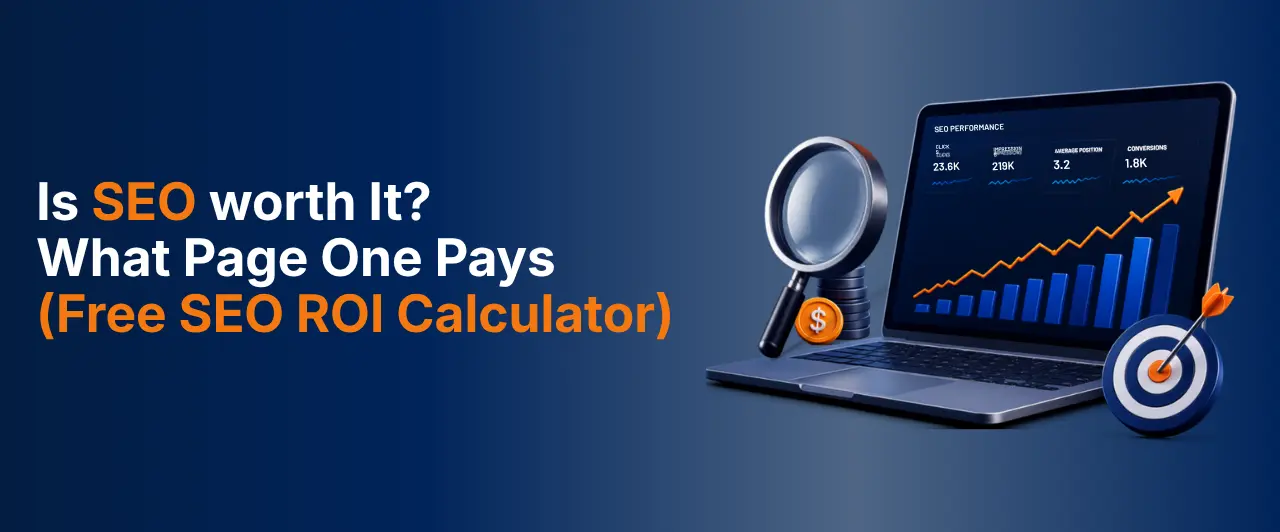
The short answer. SEO is worth it for most Australian businesses that have non-brand search demand and enough margin per customer to carry a twelve-month retainer. At the typical mid-market spend of $2,500 to $3,500 a month, you need roughly one $40,000 project a quarter at 22% gross margin before the program breaks even. Whether yours clears that bar is arithmetic, and it comes down to four numbers.
The forecast in your proposal was built on a search page that no longer exists
Most SEO forecasts still run on click-through rates measured before AI Overviews existed.
Pew Research Center tracked 68,879 Google searches from 900 adults across March 2025. When an AI summary sat at the top of the page, users clicked a traditional result on 8% of visits. With no summary present, 15%. The click rate roughly halved. Links inside the summary itself were clicked on 1% of visits.
Ahrefs re-ran their study on 300,000 keywords in December 2025 and found position-one click-through rate down 58% where an AI Overview appeared, up from 34.5% when they first measured it in April that year.
Now hold that up against the curve in your proposal, which has position one somewhere north of 30%.
Both of those studies are American. There is no Australian equivalent, which tells you a fair bit about how much of what gets sold here as SEO ROI in Australia is imported arithmetic with the dollar sign swapped.
Why the usual sum flatters itself
Three things inflate it, and they compound.
The stale click-through curve is the first and the largest. Covered above, and it alone can halve the answer.
The second hides inside your conversion rate. Your site converts organic traffic at 3.1%, so 3.1% goes into the model. Except a chunk of that traffic searched your company name. Those people already knew who you were. Pull them out and the non-brand figure often lands at half the blended one.
Third, the model's output is revenue. Your business banks margin. A $40,000 build at 22% gross margin contributes $8,800, and a forecast waving the $40,000 at you is quoting a number you can't spend.
None of this means the vendor is dodgy. Most of the SEO agencies worth hiring in Australia inherited these assumptions from tools and templates that stopped being accurate somewhere around mid-2024.
The four numbers behind SEO ROI in Australia
Everything above reduces to a chain of four numbers between a ranking and a dollar. Get one wrong and the whole answer moves.

Four multiplications. You can do it on the back of an envelope in five minutes, which is worth doing before you sit through another pitch.
Demand, and why Australian search volume is smaller than your tool says
Start by halving whatever your instinct says about market size.
Australia is 27 million people. A term showing 12,000 monthly searches globally might return 400 here, and the major keyword tools disagree with each other on how they split it.
Strip your brand terms out at this stage too. If people are already searching your company name, that's demand you own. Counting it as SEO upside is double-dipping.
The small market cuts both ways, mind you. Fewer searches, and fewer serious competitors fighting over the same page-one slots. It's the reason Australian businesses in narrow B2B niches so often end up punching above their weight in organic search.
Visibility, and what the AI Overview takes off the top
Ask one question before modelling any position. Does this query trigger an AI summary?
Here's what it costs you when it does. SISTRIX ran the numbers across more than 100 million keywords and watched position one fall like this:
That's one row of a ten-row table, and the row that hurts most. Positions two through ten each move differently, and the damage concentrates at the top; position one absorbs roughly three times what position ten does.
The reassuring part is which queries are affected. Ahrefs found 99.2% of keywords that trigger an AI Overview have informational intent. Commercial terms are largely still behaving.
So "commercial kitchen equipment sydney" runs close to the old curve. "how much does commercial kitchen equipment cost" now sits under a summary that answers it before anyone scrolls.
Both are worth ranking for. They're worth wildly different amounts of money, and any forecast pricing them identically has skipped the only step that mattered.
In the calculator. The full corrected curve, positions one through ten, with and without an AI Overview, split by commercial and informational intent. Plus AI Overview trigger rates by query type, so you can sort your own keyword list into terms that still pay and terms that now mostly buy recognition.
Conversion, and the number your dashboard won't hand you
Do this one today. It takes ten minutes and it moves your answer more than anything else on this page.
Open Google Search Console. Filter your queries to exclude your brand name and its obvious misspellings. Look at the clicks left over, then match them against enquiries logged in the same period. That ratio is your non-brand organic conversion rate, and it's the only one with any business appearing in an SEO forecast.
The gap between the two is wider than most people expect. Amsive, looking at 700,000 keywords across ten sites, found non-branded queries lost around 20% of their click-through rate to AI Overviews while branded queries picked up nearly 19%. Your blended number is being propped up by traffic that was never in play.
Which leads to the awkward bit. If you've had tracking in place for under a year, or your CRM doesn't tag lead source properly, you can't produce this figure at all. The sum stops here and there's no way around it with the data you've got.
If you haven't got this. Non-brand organic conversion benchmarks by Australian sector, so you can run the model on a defensible proxy while your own data catches up. Plus the GA4 and Search Console segment setup to start collecting the real thing from this week.
Value, and what one enquiry is worth once everything comes off
Apply your close rate, then your gross margin, and be honest about both.
Close one organic enquiry in four, at an average project of $40,000 and 22% gross margin, and a single enquiry is worth $2,200 to the business. That's the figure for the model, and it's your true cost-per-lead ceiling for any search channel.
B2B makes it messier, because the money turns up months after the click. A lead from a March search that closes in September still counts, though your reporting has to be built to see it. If your sales cycle runs long, the attribution problem is worth sorting out before the forecast, not after.
In the calculator. A one-page lead value worksheet, plus how to handle the lag without double-counting.
You've got two of the four numbers. Get the other two.
Find Out What Page One Could Really Pay You
Don’t guess your SEO ROI. This free calculator helps you estimate clicks, leads, revenue and payback based on your keywords and rankings, so you can know what your SEO investment could really be worth.
Feed in your keywords, search volume and target position. It runs them against the corrected curve and hands back your monthly leads and organic revenue. No email for that part.
The rest needs one. Payback month, what the sum looks like if you land at position six instead of two, and every benchmark table underneath the figures.
Get the SEO ROI calculator
How long before SEO pays for itself in the Australian market
Payback month is the number that settles the argument, and almost nobody in a pitch will hand you one.
Start with what you're committing to.
- Retainers for small and mid-sized Australian businesses: $1,500 to $5,000 a month
- Where the average lands: $2,500 to $3,500
- Hourly rates at reputable agencies: $140 to $250
Whatever figure you've been quoted, multiply it by twelve before you react to it. That's the commitment, and it's what your payback month has to beat.
Returns don't arrive flat against it either.
That back half is the part paid channels never give you, and the reason PPC and SEO answer different questions. If you need revenue this quarter, the cost of a YouTube campaign is a fairer comparison than an SEO retainer.
There's one more wrinkle, and it's the one that should worry you most. Seer Interactive tracked organic click-through rates falling 41% between 2024 and 2025 on queries with no AI Overview present at all, from 2.72% down to 1.62%. Whatever is compressing organic clicks, AI Overviews are not the whole of it, and a twelve-month model built on today's curve is optimistic by default.
Then there's the calendar, which nobody models and everybody lives with. Budget gets approved across May and June for the year starting 1 July. An SEO program signed in July is asking to be judged at a review that arrives before it's had time to pay. Sign in February and you're back asking for money mid-cycle, a harder conversation than the work deserves. January, as ever, is a write-off.
The businesses that get SEO over the line here walk into the EOFY conversation holding a payback month.
In the calculator. The month-by-month ramp model, the payback calculation, and Australian cost bands including how GST and EOFY timing change what you're comparing.
What changes when you can show your SEO ROI
The conversation stops being about traffic and starts being about money, which turns out to be a much shorter conversation.
Three things fall out of it.
You can kill keywords with a clear conscience. A term with volume that sits under an AI Overview and converts at nothing is quietly eating your content budget, and knowing which of your terms are in that bucket beats adding another ten.
You can hold a vendor to something. A forecast built from auditable inputs is a forecast you can check in month six, at the pointy end, when the retainer is up for renewal.
You can defend the spend when budgets tighten, because a payback month survives a CFO's questions in a way a rankings report has never managed.
A forecast you can't audit is a sales document.
The upside is real when the inputs are. Good Cycles came to us for SEO and saw a 120% increase in organic traffic alongside a 4x rise in qualified leads from search, with core service pages ranking in the top three for competitive terms. Their CEO, Kirra Johnson, wrote that up in a verified Clutch review. Their numbers run through the four-number model as the worked example inside the calculator.
🎧 How Much Is a Page-One Ranking Really Worth?

Getting to page one still matters, but the value of that ranking has changed. AI Overviews are taking clicks, traditional CTR benchmarks are becoming less reliable, and many forecasts still count branded traffic and headline revenue instead of real business margin.
In this episode, we break down the four numbers that determine SEO ROI - search demand, visibility, conversion, and lead value - and explain how Australian businesses can calculate what page-one rankings are actually worth before committing to a long-term SEO investment.
 Press play and listen.
Run your own numbers before the next budget conversation
So, is SEO worth it? For most Australian businesses with real search demand and a reasonable margin, yes. The useful version of the question is narrower. Is it worth it at this price, for these keywords, on your payback timeline.
That's arithmetic, and it's yours to do.
What the SEO Traffic-to-Revenue Calculator comes with
- The corrected CTR curve, positions one to ten, AI Overview present and absent, split by intent
- Non-brand organic conversion benchmarks by Australian sector
- The month-by-month ramp model and your payback month
- Australian SEO cost bands, with GST and EOFY treatment
- The Good Cycles worked example, start to finish in AUD
- Six questions to ask an SEO agency, and the answers that should worry you
Also inside: the downside scenario at position six, and a one-page board summary you can send without rewriting.
You're told SEO pays for itself, but nobody shows the sum. Turn your rankings into dollars.
Get the SEO ROI calculator
Common questions about SEO ROI in Australia
Is SEO worth it for small businesses in Australia?
Often, though the maths is tighter. A smaller keyword set and lower deal values mean the payback month lands later, so the honest test is whether your average customer value can carry a twelve-month retainer. Businesses with high margins or repeat purchase clear that bar comfortably. Low-margin, low-frequency ones frequently don’t.
How much does SEO cost in Australia?
Retainers for small and mid-sized businesses commonly sit between $1,500 and $5,000 a month, with the average around $2,500 to $3,500. Hourly rates at reputable agencies run $140 to $250. Quotes well below that band usually mean offshore delivery with no local strategy attached.
How long does SEO take to pay off?
Movement typically starts around month four to eight, with compounding after that. Your payback month depends on deal value and close rate more than on how fast you rank, which is why modelling it beats guessing at it.
Is SEO still worth it now that AI Overviews exist?
For commercial and transactional terms, largely yes, since 99.2% of AI Overview triggers are informational queries. For informational content the return has fallen sharply and the case now rests on brand recognition and citation rather than clicks.
How do I calculate SEO ROI myself?
Multiply monthly search volume by your click-through rate at the target position, then by your non-brand organic conversion rate, then by the value of one enquiry after close rate and gross margin. Compare that against twelve months of retainer to find your payback month.
Prefer someone else pulled your inputs? We’ll pull the four numbers for your own site and walk you through them. We work with businesses across the country from our Sydney office, including Melbourne, Perth and Brisbane.


Associate Director - Digital Marketing
As an Associate Director of Digital Marketing with over 18 years of experience, I bridge the gap between complex web technology and high-impact strategy. I specialize in scaling growth across eCommerce, services, and SaaS-based product portfolios through a mix of advanced SEO, AEO, SXO, GA4 analytics, and paid channels like Google and Meta—all while empowering high-performing teams to deliver measurable, real-world business results.