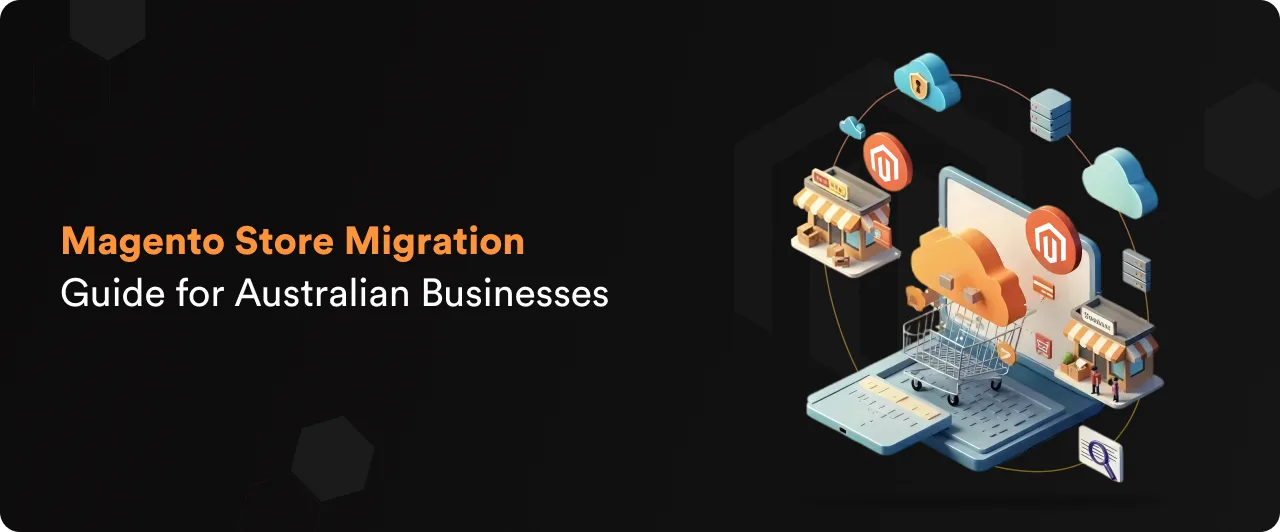
If you’re running an ecommerce business in Australia, you’ve probably run into Magento and Adobe Commerce pretty quickly.
Maybe you’re planning a new store. Maybe your current setup’s starting to feel tight. Either way, these two keep coming up. Same family, technically. But they don’t behave the same once you’re actually in it, trying to run a business.
And that’s where things get a bit less clear. Because it’s not really a “which one is better” situation. It’s more like what kind of trade-offs are you okay with for your business?
Magento Open Source Vs Adobe Commerce
Magento, the original one, is open source. You can download it, shape it however you want, build something pretty custom if you’ve got the right people.
Adobe Commerce sits on top of that. Same foundation, just expanded. More features baked in, more support, and yeah, a much bigger price attached. So they overlap. A lot. But once you start working with them, they don’t feel interchangeable.
Magento Is Open Source: Flexible, But Not Exactly Low-Effort
This is where plenty of Australian businesses begin. No licensing fee, no lock-in, full control. Sounds ideal on paper.
Then the practical side kicks in. Hosting, development, extensions, fixes. None of that’s free. It’s just spread out instead of upfront. Some businesses handle it fine. Others realise a bit late that “free” still needs a budget behind it.
Working with a team doing Magento development in Australia tends to smooth things out. Not just technically, but things like GST, local payment gateways, and shipping quirks.
It works well when you want that control. When you’re okay with being involved. Or when you’ve already got developers in the picture and don’t mind leaning on them. A lot of brands working with Magento development in Sydney teams stick with this setup for that exact reason.
Adobe Commerce: Advanced Scalability
Then there’s Adobe Commerce, which feels different almost immediately. You’re not building everything from the ground up. A lot of it’s already there. Analytics, customer segmentation, B2B features, and even AI-driven recommendations.
It’s more complete. That’s the appeal. Also means less patchwork. Fewer plugins, fewer workarounds. At least in theory. But it’s not simple. Most businesses still need an Adobe Commerce agency to make sense of it all, otherwise those “built-in features” just sit there unused.
Where The Differences Actually Show Up?
Cost
- Magento Open Source starts cheap. Then grows with you. More features, more customisation, more spend. It creeps up.
- Adobe Commerce does the opposite. Big upfront investment, but fewer add-ons later because a lot’s already included.
Which one ends up costing more? Depends how far you push things.
Ease of Use
Magento needs hands-on work. Adobe Commerce reduces some of that, but you’re still not running it solo unless you’re pretty technical. You can hire an Adobe Commerce agency to help you with the setup.
Scaling
- This is where the gap widens a bit. Adobe Commerce handles larger setups more comfortably. Big catalogues, multiple stores, heavy traffic. It’s built for that.
- Magento can get there too, but it usually needs more tuning along the way. More input. More maintenance.
Features
Magento gives you the basics and lets you build from there. Adobe Commerce shows up with a lot already done. Personalisation, advanced promotions, deeper insights into customers. If marketing is a big driver for your business, that difference becomes hard to ignore.
Magento vs Adobe Commerce for Australian Businesses
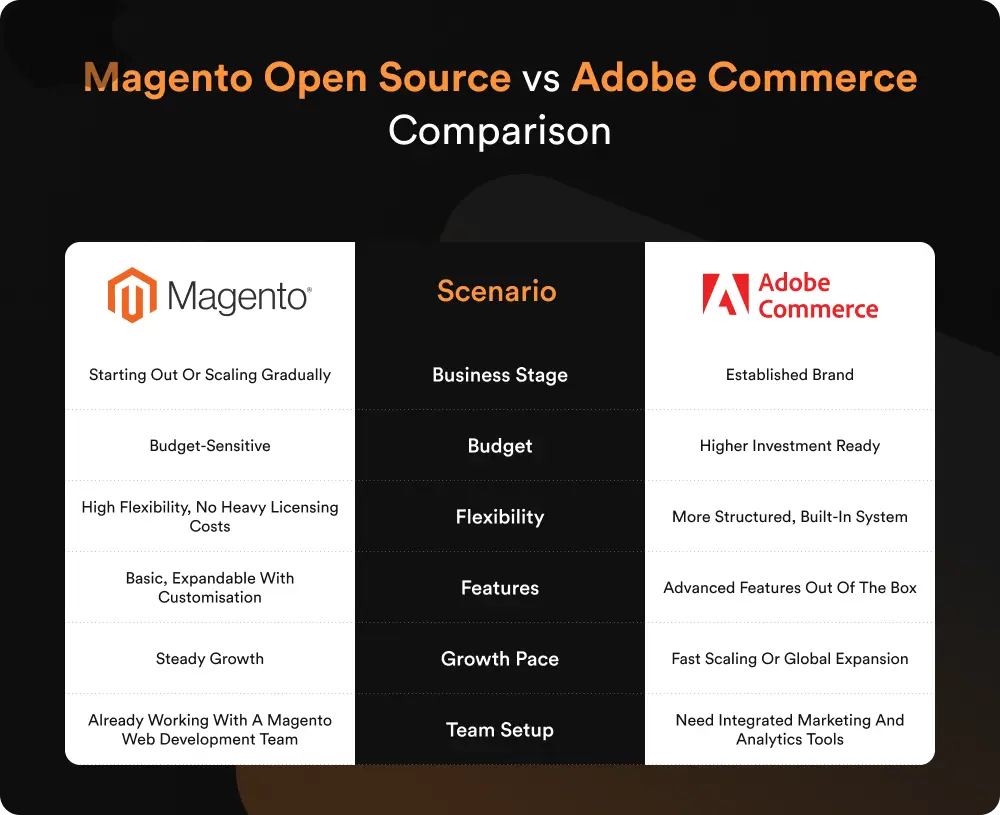
For many Australian businesses, Magento Open Source is the starting point, and Adobe Commerce becomes the upgrade later.
🎙️Magento vs Adobe Commerce: What Actually Works for Your Business

If you’re deciding between Magento Open Source and Adobe Commerce, this episode breaks it down in a way that actually makes sense for real businesses.
We talk through cost, flexibility, scalability, and what day-to-day operations look like on each platform.
No generic comparisons, just practical insights based on how businesses actually use them.
If you’re planning your next ecommerce move, this will help you make a clearer call
Start Your Business Setup With Magento Web Development Experts
It usually circles back to the same thing. Magento Open Source gives you freedom. But it expects you to be involved. Adobe Commerce gives you more structure. But you pay for that upfront, whether you use everything or not. The better choice is about what your business can handle right now without overcomplicating things.
Frequently Asked Questions (FAQs)
Magento Open Source is a free and flexible ecommerce platform. Adobe Commerce is its premium version with advanced features, support, and optional cloud hosting.
Magento works well for startups and growing businesses. Adobe Commerce is better suited for established companies. It comes with advanced features and scalability.
It can be, especially for businesses that will use its built-in tools for automation, personalisation, and scaling operations.
Yes, many businesses start with Magento. They upgrade later as their needs grow, though the process requires proper planning.
Generally yes. Adobe Commerce is designed to handle larger, more complex ecommerce operations with greater efficiency.