Software development stopped being a back-end concern a long time ago. Whether you’re running a trades business in Western Sydney or a professional services firm in the CBD, your software either supports how you operate or quietly works against it.
Australia’s digital economy grew 8.4% in 2024, and more businesses are putting real money into custom software, automation, and cloud infrastructure. 2026 brings changes worth paying attention to.
Some have been building for years and are finally hitting mainstream adoption. Others are newer — regulatory shifts, competitive pressures, technical developments — and they’ll catch businesses off guard if the first time you hear about them is when they become a problem.
Knowing the latest software development trends isn’t about staying current. It’s about spotting what has actual consequences for your operations before it becomes urgent.
Top 8 Software Development Trends for 2026
1. AI-Augmented Development
AI isn’t replacing developers. It’s making them faster. Tools like GitHub Copilot are now embedded in daily coding workflows. They reduce build times and costs. The catch? You still need experienced engineers who know when to trust the output and when to override it.
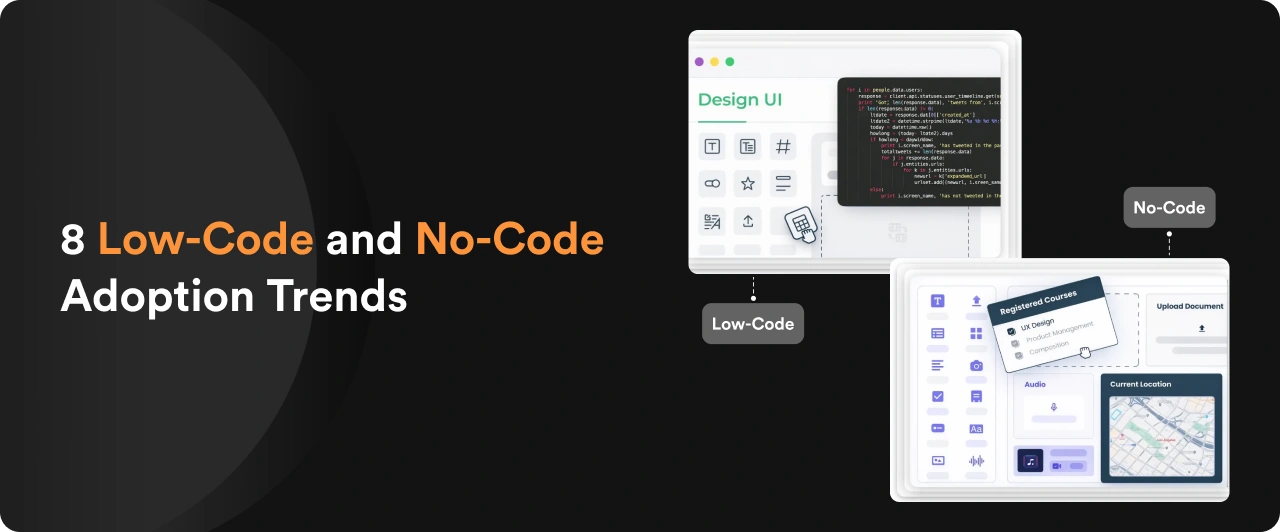
2. Low-Code and No-Code Platforms Maturing Fast
These platforms have grown up. What used to be limited to basic internal tools can now handle genuinely complex workflows. If you’ve been told custom software is out of reach for a business your size, that gap is closing fast.
3. Edge Computing
Data processing is moving closer to where it’s generated — on devices, in stores, in the field. For Australian businesses dealing with remote locations or latency-sensitive applications, this matters more than it does in more densely connected markets overseas.
4. Cybersecurity-First Development
The ASD reported a 23% jump in cyber incidents hitting small-to-medium businesses in 2025. That’s not a large-enterprise problem anymore — it’s yours. Businesses that treat security as a final checklist item before launch are the ones ending up in breach notification territory. DevSecOps flips that approach. It helps to build security into every stage of development.
5. Cloud-Native Architecture
Microservices, containers, and serverless functions are now replacing monolithic systems. This allows your software to scale without a full rebuild. If you’re planning growth, this architecture handles demand spikes at a fraction of the cost of older approaches.
6. API-First Design
Businesses aren’t building isolated software anymore. Your payment system talks to your CRM, which connects to your inventory tool. API-first design means every piece of software is built to integrate from the start — not patched together later when it gets expensive.
7. Sustainable and Green Software Engineering
Australian consumers pay attention to how businesses operate, and that now includes digital infrastructure. Efficient code that uses less compute power cuts your electricity costs and strengthens your ESG position — two things that are increasingly relevant to investors and customers alike.
8. Hyperautomation
Robotic Process Automation, combined with AI, now handles multi-step business processes, not just single repetitive tasks. Invoice processing, customer onboarding, compliance checks — these are all being automated end-to-end. The latest software development trends consistently point to businesses doing more without proportionally growing headcount.
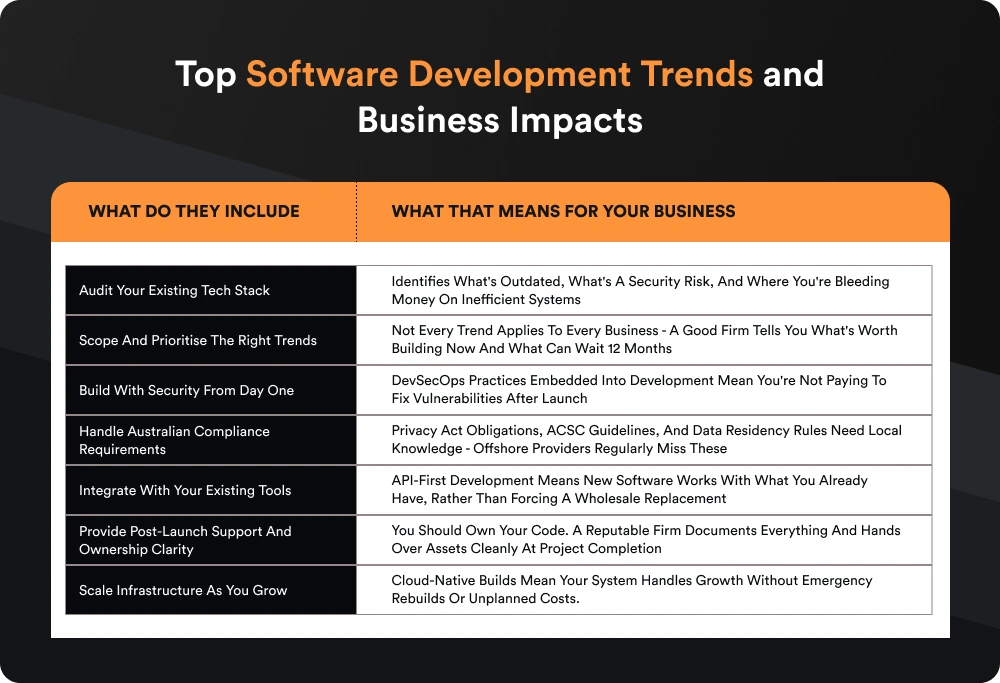
Top Software Development Trends and Business Impacts
🎙 Podcast: Software Trends Australian Businesses Can’t Ignore

Software is now shaping how businesses operate, scale, and compete.
In this episode, we break down 8 software development trends that are changing how Australian companies build and use technology.
From AI-assisted coding to hyperautomation and cloud-native systems, these shifts have real business impact.
Listen to this podcast to understand which trends are worth acting on in 2026.
Conclusion
2026 isn’t a year to watch and wait. The latest software development trends covered here have direct cost, risk, and revenue implications for Australian businesses of every size. The right software development company will help you identify what’s worth building now.
Frequently Asked Questions (FAQs)
AI-augmented development and low-code/no-code platforms are the two most dominating trends. Others include edge computing, DevSecOps, and cloud-native architecture.
It’s handling the routine work. This includes code writing, testing, and documentation. It helps developers move faster. Your business gets shorter timelines and more output without adding headcount.
Internal tools typically run $15,000–$50,000 AUD. Customer-facing applications with integrations and support land closer to $80,000–$250,000. Maintenance and scaling will add to that number over time.
LLMs, serverless infrastructure, and API-driven architecture. Australian businesses also need to factor in data sovereignty.