














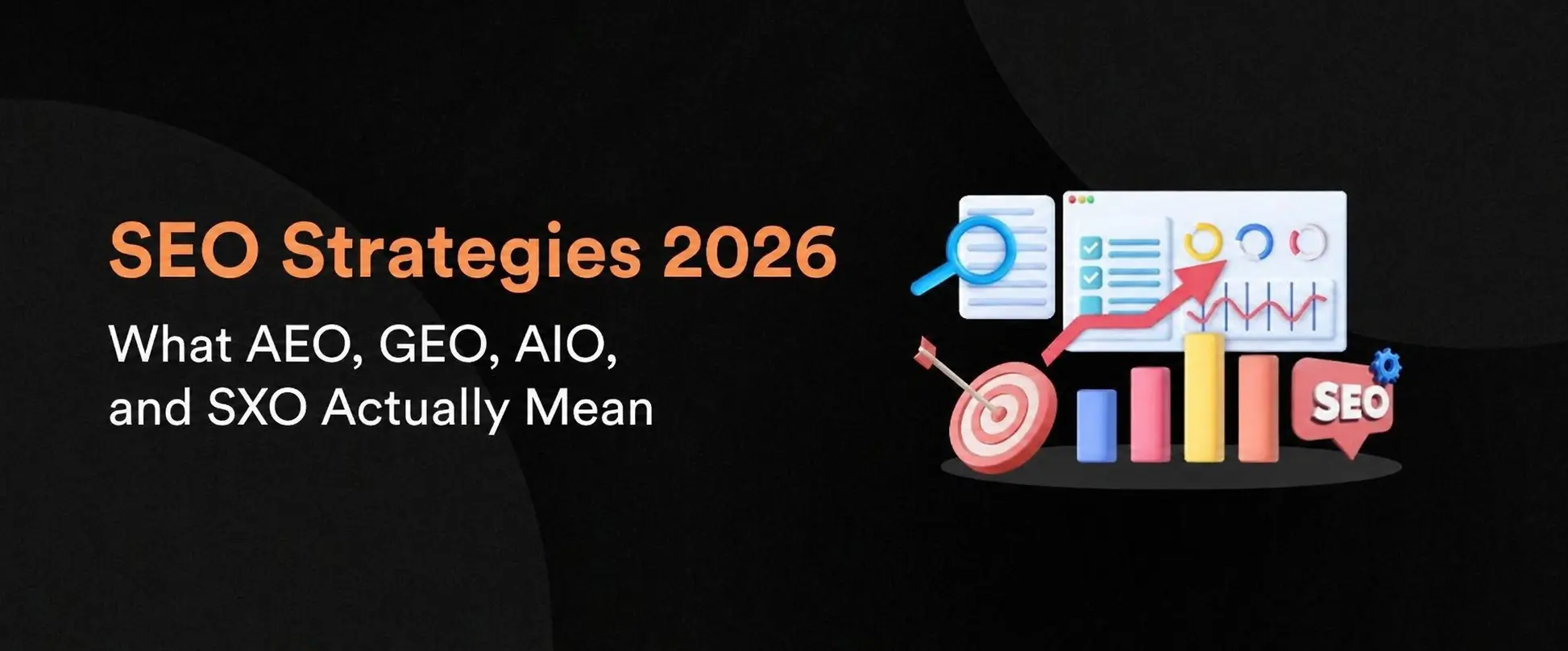
SEO in 2026 has moved well past keyword stuffing. It has become much smarter- and much more exciting. When you own a company in Australia and you keep wondering what AEO, GEO, AIO, and SXO refer to, you are not the only one.
These are not mere fancy acronyms that the SEO services in Australia employ to appear smart. They are revolutionary tactics that will make your site a success, or it will be a casualty in the digital jungle. This is what they are and why they are important to your bottom line.
Quick answer: AEO is about winning the direct answer, whether that is a featured snippet, a voice result or an AI summary. GEO targets the AI engines themselves, so ChatGPT and Gemini pull from your content when they write their own responses. AIO covers two things people mean by the same acronym: optimising for AI Overviews, and using AI tools to run your optimisation. SXO joins SEO to user experience, on the basis that traffic which bounces is worth nothing. Most Australian businesses should start with AEO, since the structural work it needs also feeds the other three.
What is AEO (Answer Engine Optimization)?
Consider AEO as an intelligent cousin of SEO. Whereas traditional SEO is focused on ranking high on the search page, the AEO is focused on the featured snippets, voice search results, and answers that are generated by AI and appear even before the user clicks through to your site.
The question of what is AEO vs SEO boils down to is intent. SEO makes you findable; AEO makes you the one the customer goes to first when he or she is seeking an answer. It is about being the one people come to so that the search engines can put it directly in their results.
Key AEO Strategies:
- Structure your content with clear questions and answers
- Use schema markup to help search engines understand your content
- Create comprehensive FAQ sections
- Optimise for conversational, long-tail keywords
- Focus on E-E-A-T (Experience, Expertise, Authoritativeness, Trustworthiness)
What is GEO (Generative Engine Optimization)?
GEO can be called the most recent arrival, as it is specifically tailored to the AI-powered search engines such as ChatGPT, Google Gemini, and Microsoft Copilot. These engines do not merely deliver linked material. They come up with original responses based on your content.
This has been perfected by Sydney-based fintech Zip Co, which produces detailed, official content regarding the buy-now-pay-later services. When these AI engines are giving answers regarding the BNPL options, Zip content is often the basis of the responses.
GEO Essentials:
- Create complete, topic-cluster content
- Use natural language and conversational tone
- Include relevant statistics and data points
- Maintain factual accuracy and cite sources
What is AIO (Artificial Intelligence Optimization)?
AIO gets used two ways, and it is worth knowing both before someone sells you one of them.
The first meaning is optimising for AI Overviews, the summaries Google now places above the traditional results. Work here overlaps heavily with AEO: clean structure, schema markup, and answers written so a machine can lift them without mangling the meaning.
The second meaning is using AI to run your optimisation, so analysing performance, spotting content gaps and drafting at a speed no human team matches. This is closer to a workflow change than a ranking strategy.
Both are real. Neither replaces the other. When an agency quotes you for AIO, ask which one they mean, because the deliverables look nothing alike.
Canva is a good example of the second meaning. Since 2023, Canva in Sydney has been making use of AIO, which employs AI in analysing the behavioural patterns of users and auto-optimising their content strategy. They have made it the norm that they are ranked top 3 with queries related to design in Australia in their blog posts.
What is SXO (Search Experience Optimization)?
SXO is a union of SEO and UX (User Experience). You cannot just have visitors coming to your site, but you have to keep them there, interact and convert them. SXO is concerned with the complete user path, on search query, and on conversion.
Afterpay, now owned by Block, transformed how they approach SXO when they developed customised landing pages according to the particular search intentions. Their bounce rate went down by 40%, and conversion went up by 65%.
Why These Strategies Matter in 2026?

It is enjoyable to know the acronyms, but understanding why they matter to your business in 2026 is the part that pays. The online environment has changed to such an extent that the SEO hacks that you used are as much use as a chocolate teapot.
The Shift Towards Zero-Click Searches
Over half of the searches are not clicked anymore. It is here where AEO comes in. When people are finding their answers through the search results, you want to be the one presenting such answers.
AI-Powered Search Revolution
SEO in 2026 turns heavily on AI compatibility with the integration of ChatGPT and AI Overviews on search engines and Google. The companies that fail to integrate GEO and AIO will be somewhere in the shadows of this new environment.
AI Mode arrived in Australia in October 2025. It runs on a custom version of Google's Gemini models and handles longer, multi-part questions that would previously have taken several searches. For Australian businesses this shifts the target: the aim is being cited inside the answer rather than ranking beneath it.
The Australian SEO Landscape in 2026
A roadmap is the beginning of every successful SEO approach. It is not possible to simply fling resources out at every acronym and expect something to stick. This is how the four strategies compare with each other regarding effort, time frame, and anticipated outcomes of Australian businesses.

Real Australian Success Stories
With the introduction of thorough SXO strategies, Gumtree Australia changed its SEO strategy. Their redesigned search results pages improved user intent, which improved organic traffic by 45% and user engagement by 30%. Domain.com.au was able to take advantage of the AEO by producing suburb guides that were heavily structured, data-marked and marked-up. When a user types in their search as best suburbs in Sydney, there is an 80% probability that Domain will be displayed as featured snippets. Woolworths employs AIO so as to optimise its grocery-related content. Their AI helps them analyse seasonal trends, local events, and shopping patterns and automatically update their product descriptions and blog content, making them ahead of their competitors.
Implementing Your 2026 SEO Strategy
All right, enough theory, let's get practical. You must be saying to yourself. All this sounds good, so where do I begin? The good part is that you do not have to do all of it at the same time. Your game plan to implement these strategies without losing your mind step by step is here.
Start with AEO Foundations
First, do a bit of a stop-gap on your existing material and determine whether it is very question-based in terms of its keyword structure. Australians are posing questions such as What is the best coffee shop around me? Or what is the procedure for seeking a business loan in NSW?
Quick AEO Wins:
- Add FAQ sections to your key pages
- Use question-based headings
- Include local Australian terms and colloquialisms
- Optimise for “near me” searches
Build Your GEO Strategy
After you have identified those keywords, make complete, in-depth guides in a way that AI engines are keen to refer to you more than others. Consider being the reference point to the hot topics in your industry, and not the site that stuffs everything with keywords.
Leverage AI for Optimization
Adopt the AI revolution instead of struggling with it. Track your content performance and discover the gaps using AI tools and optimize it to perform well both with people and search engines.
Essential SXO Elements:
- Fast loading times (under 3 seconds)
- Mobile-first design
- Clear navigation structure
- Compelling calls-to-action
- Personalised user experiences
Skip the llms.txt File
You will see llms.txt recommended everywhere at the moment. The evidence does not support it. Google's Gary Illyes confirmed in July 2025 that Google does not support the file and has no plans to, and John Mueller compared it to the old keywords meta tag, which search engines stopped trusting fifteen years ago for the same reason. An Ahrefs study covering 137,000 sites found that 97% of llms.txt files were never fetched at all, and that AI crawlers never went looking for the file on sites that did not have one.
There is one real use case. Developer documentation sites benefit, because coding assistants can be pointed at the file directly by the user. If you sell software to developers, add it. Everyone else is better off putting the same hour into structured data and topical depth.
Podcast: Decoding SEO in 2026 – AEO, GEO, AIO & SXO Explained

Not in the mood to read? Pop in your headphones and tune in. In this episode, we break down the new pillars of SEO in 2026, and what AEO, GEO, AIO and SXO actually mean, how they work together, and why they matter for your Australian business.
 Press play and listen.
Conclusion
It does not matter whether it is AEO, GEO, AIO, or SXO anymore; the future of SEO is all of them collaborating. Businesses in Australia that get this integrated strategy will dominate their markets as others maintain the old gimmicks.
The local SEO agency in Australia landscape is changing rapidly, and those who strike first will get the largest rewards. Competitors have already charted such strategies. The question is, will you roll them out before they do?

Our team of Australian SEO experts will audit your current strategy, identify opportunities, and create a personalised roadmap for 2026 success. We'll show you exactly how to implement AEO, GEO, AIO, and SXO strategies that work for Australian businesses. Book your complimentary strategy session today.
Frequently Asked Questions (FAQs)
What is the difference between SEO, AEO and GEO?
SEO gets you into the ranked list of links. AEO gets you into the answer sitting above that list. GEO aims further along again, at the AI engines themselves, so ChatGPT or Gemini draws on your content when writing its own response. The underlying work overlaps more than the acronyms suggest.
How do you optimise content for AI Overviews?
Answer the question inside the first two sentences, then support it. Add FAQ and Article schema so the structure is machine readable. Keep claims specific and cite your sources, since AI systems lean on content they can verify. Skip llms.txt, because Google has confirmed it does not use the file.
What is generative engine optimisation?
GEO is the work of getting cited when an AI engine writes its own answer. There is no ranking position to hold, so the measure is whether you appear at all. Depth on one topic counts for more than keyword coverage, along with writing plainly enough that a model can quote you accurately.
Is traditional SEO still relevant in 2026?
Yes, and more than the headlines suggest. AI search systems ground their answers in ordinary web results, so the sites that rank are the sites getting cited. Crawlability, page speed and internal linking still decide whether you make that pool. Ranking now gets you considered for the answer rather than being the goal itself.
What is answer engine optimisation?
AEO is structuring your content so a search engine can lift a direct answer out of it. That covers voice results, featured snippets and the summaries Google places above the links. The work comes down to question-based headings, short answers beneath them, and schema markup that tells the engine what it is reading.
What is SXO and does it affect rankings?
SXO joins SEO to user experience. Winning the click is only half the job, since a visitor who leaves within seconds tells Google the page did not answer the query. Page speed, mobile layout and a clear next step all sit inside SXO, and all feed the engagement signals rankings rely on.


Associate Director - Digital Marketing
As an Associate Director of Digital Marketing with over 18 years of experience, I bridge the gap between complex web technology and high-impact strategy. I specialize in scaling growth across eCommerce, services, and SaaS-based product portfolios through a mix of advanced SEO, AEO, SXO, GA4 analytics, and paid channels like Google and Meta—all while empowering high-performing teams to deliver measurable, real-world business results.