The backend determines whether your web product holds together when it matters most. A weak backend stack doesn’t announce itself on day one. It shows up six months later when load times creep up, or servers buckle under traffic.
Scalability isn’t a feature to add later. It’s a foundational decision made before a single line of code is written. That’s why many product teams bring in a web app development company early — not to outsource the thinking, but to pressure-test it.
Teams that have built at scale recognize failure patterns that aren’t obvious until you’ve seen them firsthand.
What “Scalable Backend Stack” Actually Means?
The phrase gets used loosely. Let’s break it down practically.
The Stack
A backend stack is the combination of technologies powering your server-side logic. Think of it as layers:
Layer | Role |
Programming Language | The foundation of everything else is written in |
Framework | Gives structure to your application code |
Database | Stores, retrieves, and manages your data |
Hosting Infrastructure | The environment where your app actually runs |
APIs & Integrations | Connects your app to external services |
DevOps & Monitoring | Manages deployment, uptime, and issue detection |
Each layer affects the others. A fast language running on a poorly indexed database is still a slow app.
Scalability — Vertical vs Horizontal
Vertical scaling means upgrading the server — more CPU, more RAM.
Horizontal scaling means adding more servers and spreading the load. This is where real scalability lives.
What to Think About Before Picking a Stack?
Skipping this step is where most architectural regret starts. Technology decisions should follow business and product decisions — not the other way around.
Project Scope and Complexity
An MVP and an enterprise platform are completely different problems. One needs speed. The other needs structure. Building an MVP with enterprise-grade architecture wastes resources. Building an enterprise platform on MVP architecture creates expensive problems.
Key questions worth answering first:
- Does the app need real-time features like live updates or collaborative editing?
- Will AI or ML models be part of the product?
- How many third-party services need to integrate?
Traffic and Growth Projections
Current user numbers rarely tell the full story. What matters more is the growth trajectory.
Consider concurrent users at launch and at 18 months. Think about whether data volume grows steadily or in sudden spikes. Factor in geography — a globally distributed user base needs a different infrastructure strategy than a regionally concentrated one.
Performance Requirements
Not all apps have the same tolerance for latency. A trading platform where milliseconds carry financial weight operates completely differently from a content platform optimized for volume. Define acceptable API response times, real-time update frequency, and latency thresholds before evaluating any technology.
Security and Compliance
Regulatory requirements aren’t an afterthought. You need to consider GDPR, HIPAA, and SOC 2 requirements. The backend stack needs to support these requirements natively. You can afford to do workarounds bolted on after the fact.
Developer Availability and Long-Term Maintenance
The technically superior stack that nobody on the team knows is not the right choice. Stacks like Node.js and Python have large communities. Popular frameworks have strong documentation and a wide hiring pool. That’s worth a lot when the original developers move on, and new engineers need to get up to speed quickly.
Budget Across the Full Lifecycle
Most teams budget for development. Fewer budget honestly for infrastructure and maintenance. A stack that’s cheap to build on can become expensive to run at scale. Professional web app development services help match technology choices to real budget constraints across all three phases — not just the build.
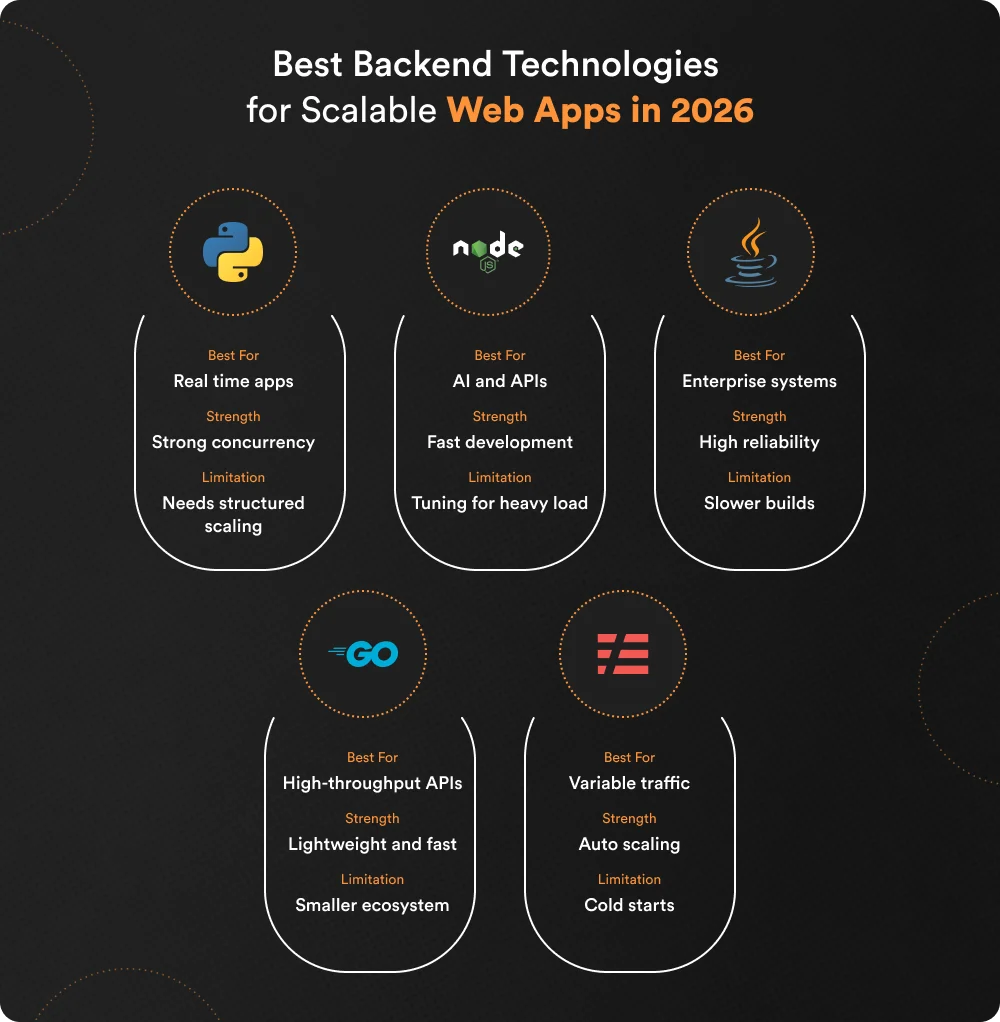
The Main Scalable Backend Stacks Worth Considering in 2026
There’s no universally correct answer. The right stack depends on what the product needs. Here’s how the main options compare:
What Does It Actually Cost to Build a Scalable Backend?
Cost is contextual. But this framework gives a realistic picture of where money goes.
Cost Category | MVP | Growth-Stage Platform | Cost (%) |
Development | Moderate | Higher (architecture complexity) | 30-40% |
Infrastructure | Low initially | Medium, growing with users | 10-20% |
Overall cost | Minimal | Moderate | 40-50% |
🎙️ Choosing a Scalable Backend Stack for 2026

Choosing a backend stack is more than a technical decision. It shapes how your product performs as users grow and demands increase. In this episode, we break down what scalability really means and when Node, Python, Go, Java, or serverless make sense. If you want to avoid rebuilding later, this conversation will help you plan smarter from the start.
The Architecture You Build Today Shapes the Product You Can Build Tomorrow
The stacks covered here all have real strengths. Matching the right one to a specific product requires an honest assessment of the product’s needs. Before you jump in to select a trending backend, consider your business’s growth trajectory.
Frequently Asked Questions (FAQs)
No single stack is universally best. Node.js, Python, Java, and Go all have genuine strengths. The right choice fits the specific product and context.
Costs vary significantly by complexity. MVPs require moderate investment. Enterprise systems cost more due to architecture work. Getting architecture right early is always cheaper than making fixes later.
Start with the project scope and expected traffic. Add performance requirements, compliance obligations, and developer availability. Don’t forget to consider the total lifecycle cost. Long-term maintainability usually matters more than short-term development speed.
Prioritize microservices and scalable databases. Load test before launch — don’t wait for real traffic to find where the system breaks.