Let’s imagine, your ecommerce store makes 15,000 orders per month. But your team wastes three hours daily moving data between systems that refuse to talk to each other. You’re spending on several tools for multiple uses in SaaS, in which you have developers spend half their time just building workarounds for creating a simple report.
Here’s the thing, this isn’t about features or pricing tiers. It’s about whether your software works for you, or you’re constantly working around your software. With Australian online spending hitting $69 billion in 2024 and over 9.8 million households shopping online, that difference affects your ability to compete.
Partnering with a web application development company that gets your specific challenges can mean the difference between scaling smoothly and constantly fighting against tools.
The Hidden Price of Off-the-Shelf
Monthly subscriptions look simple enough. Fifty bucks per user. Two hundred for the pro plan. Easy to budget.
But what about the time your team loses working around limitations? The extra tools you buy to bridge gaps? The integrations that cost more? The productivity drain from jumping between platforms that don’t sync?
Here’s what the real numbers look like for a 40-person operation:
- Licence fees: $28,800 yearly
- Add-ons and integrations: $7,200 yearly
- Lost productivity (15 minutes per person daily): $176,000 yearly
- First year total: $222,000
- Following years: $212,000 yearly
That productivity loss is the silent budget killer. When someone exports a CSV, cleans it up in Excel, then uploads it somewhere else three times a week, that’s not just annoying. It’s expensive, error-prone, and gets worse as you grow.
Many Australian businesses on Shopify or WooCommerce love these platforms initially. They’re brilliant for standard retail. But the moment you need custom pricing for B2B clients, complex product bundles, or tight ERP integration, you’re either buying expensive apps or building workarounds anyway.
When Custom Development Makes Financial Sense?
Custom web app development services need bigger upfront investment. Most projects run $50,000 to $300,000 based on features and complexity. That’s serious money requiring clear justification.
But watch what happens when you own the solution instead of renting it.
Same 40-person team, different approach:
- Development cost: $180,000
- Annual hosting: $12,000
- Efficiency gains (70% improvement): $52,800 yearly saved
- First year total: $244,800
- Following years: $91,800 yearly
You break even around 2.3 months into year two. After that, you’re saving over $120,000 annually compared to the subscription model.
The Iconic didn’t become one of Australia’s top ecommerce platforms using generic tools. They invested in custom web app development handling their specific logistics, customer experience, and scale requirements. They’ve raised $92 million and achieved over 1 million app downloads because their technology became an advantage, not just another monthly bill.
Why This Matters for Competition?
Coles Online and Woolworths Online are the leaders in Australian grocery ecommerce because they developed systems for their specific requirements. These include real-time stock levels in hundreds of stores, complex delivery coordination, and personalisation based on shopping patterns and checkout optimised for speed.
When 70% of Australian shoppers expect personalised experiences, having the same recommendation engine as everyone else won’t differentiate you.
Custom solutions deliver what generic platforms can’t:
- Your exact workflow, not someone else’s template. Your approval chains, team roles, and business logic built precisely how you operate.
- Data that makes sense for you. Information structured for your reporting needs without reformatting across multiple tools.
How to Choose What’s Right?
This isn’t all-or-nothing. Smart businesses use off-the-shelf where it works and invest custom where differentiation matters. Here’s a practical guide:
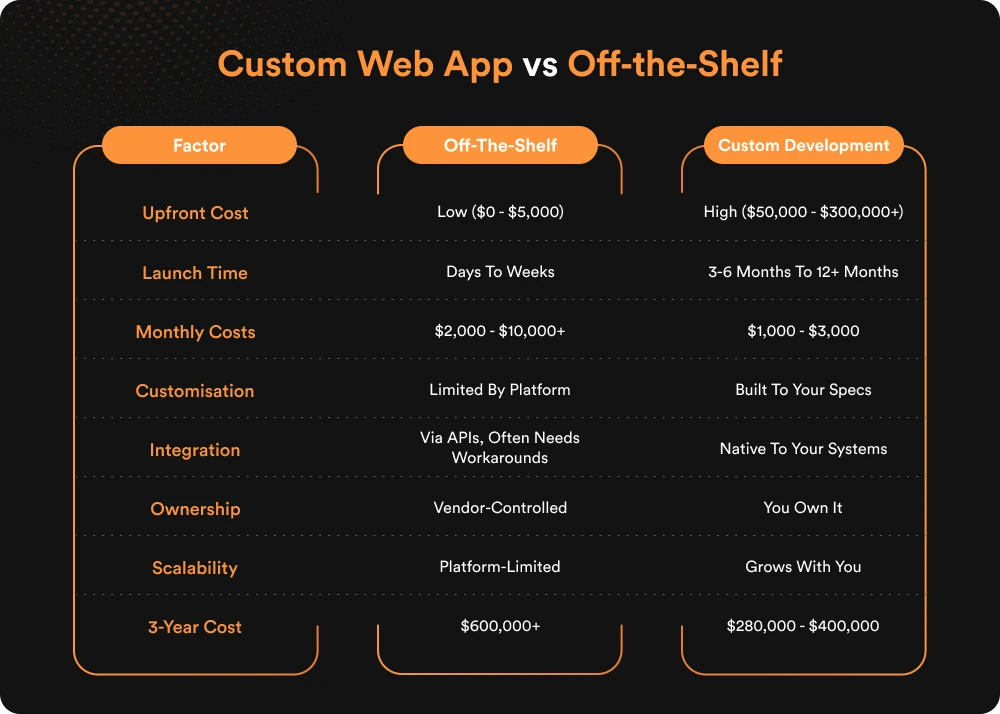
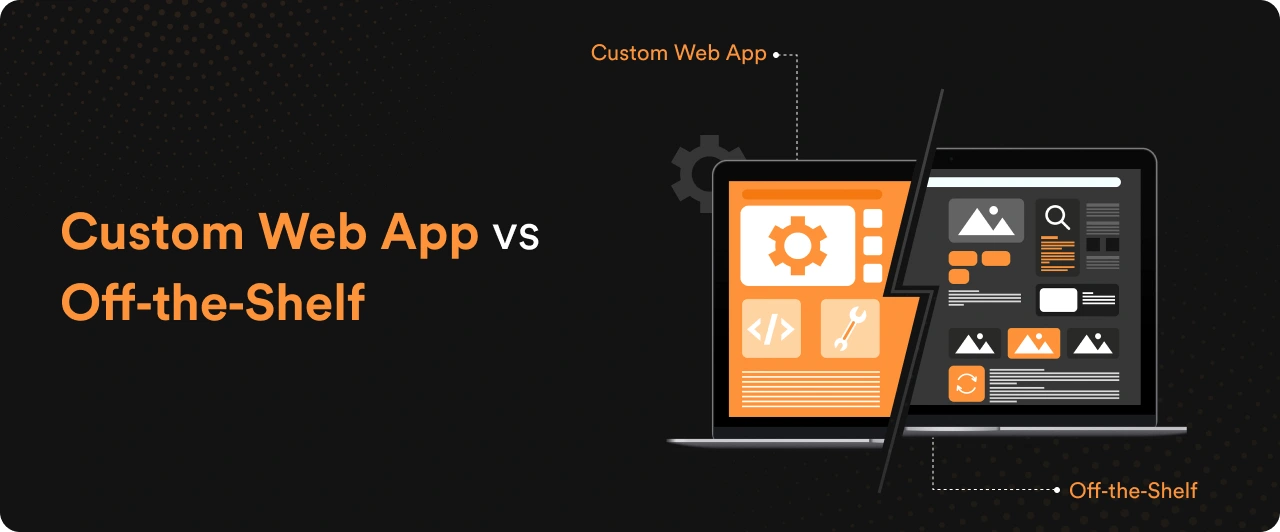
Go off-the-shelf if your process is near to industry standards, you don’t need speed, and you’re testing some ideas. Go custom when your workflow is unique, you’re fighting process friction, and current tools limit growth.
Winners aren’t always the ones with the most features. They’re the ones whose technology enables speed and customer experience that competitors can’t match with generic subscriptions.
What This Means Moving Forward?
Australian ecommerce to reach $108 billion by 2030. Competition isn’t about having a website anymore. It’s about having systems that let you move faster and serve customers better than businesses stuck in generic platforms.
Think about what changes when technology actually fits your business:
Your team stops wasting time on workarounds. Data flows automatically instead of living in spreadsheet exports. You implement new features in days instead of waiting for vendor roadmaps. Customer experience becomes your differentiator. Your cost per transaction decreases as you scale instead of increasing with per-user pricing.
Making Your Decision
Choosing between custom and off-the-shelf means understanding where flexibility matters and where standardisation works fine. Most growing Australian ecommerce businesses use both custom web app development for core operations that create a competitive advantage, supported by off-the-shelf solutions as well.
Businesses that scale successfully don’t just track subscription costs. They quantify the cost of limitations, the value of time saved, and the revenue that is enabled by having systems that work the way that they need them to.
If your team is taking hours on workarounds, if you’re running into platform walls or if your tools are your bottleneck, not your enabler, that’s your signal. The question isn’t whether custom costs more upfront. It’s whether renting generic software is actually more expensive long-term.
Your technology should grow with you, not scale against you.
🎙️ Podcast: Is Custom Web App Development Worth the Investment?

In this episode, we talk through the real differences between custom web app development and off-the-shelf software for Australian businesses. We look at where productivity gets lost, how integrations and scalability affect long-term costs, and when partnering with a web application development company actually makes sense.
Work with Experts Who Get Australian Ecommerce
Building solutions that deliver measurable ROI takes more than technical skill. It takes understanding Australian market dynamics and what drives real business results.
VT Digital works with SMBs and enterprise organisations across Australia, delivering feature-rich, powerful web applications that become competitive advantages. The best time to stop paying for software limitations was yesterday. Second-best is today.
Frequently Asked Questions (FAQs)
Custom is often the best value for long-term ROI for unique workflow for businesses with significant scale. While there are initial costs involved, with a custom there are no recurring fees, less inefficiencies, and typically pay itself off in 2-3 years. Off-the-shelf is more suitable for standard processes and businesses that are in the early stages and have a priority of speed.
Decide on custom if your processes don’t fit templates, your team is wasting a lot of time doing work around, need native system integration or existing tools restrict scale. Businesses who are losing $100k+ per year to software limitations will often have a great ROI in 18-24 months.
Evaluate your website’s interactivity with calculation of workflow uniqueness, team size, growing trajectory and integration requirements. Calculate total ownership cost for the period of 3-5 years including licences, add-ons, and productivity loss. An off-the-shelf solution suits the standard processes against tight budgets.