
Salesforce has a strong reputation. Most businesses don’t question the platform itself. What they do struggle with is making it work the way they expected. You’ll often hear that a large percentage of CRM projects underperform or fail.
Not because the tool is wrong, but because the way it’s implemented doesn’t match the business. For many Australian mid-market companies, this becomes clear a few months in. Low usage, messy data, processes that feel harder instead of easier.
The good news is that most of these Salesforce implementation problems are predictable. And avoidable when you work with the right Salesforce implementation partner.
Why Salesforce Implementations Fail More Often Than You Think?
When people talk about Salesforce implementation failure, they usually imagine something going completely wrong. In reality, it’s more subtle. The system works, but not well enough. Teams avoid using it. Reports aren’t trusted. The return on investment feels unclear.
This usually comes down to planning and execution. Mid-sized businesses often move quickly, and Salesforce gets implemented in the same way. Without enough structure behind it. That’s where things start to slip.
8 Common Salesforce Implementation Problems (and Fixes)
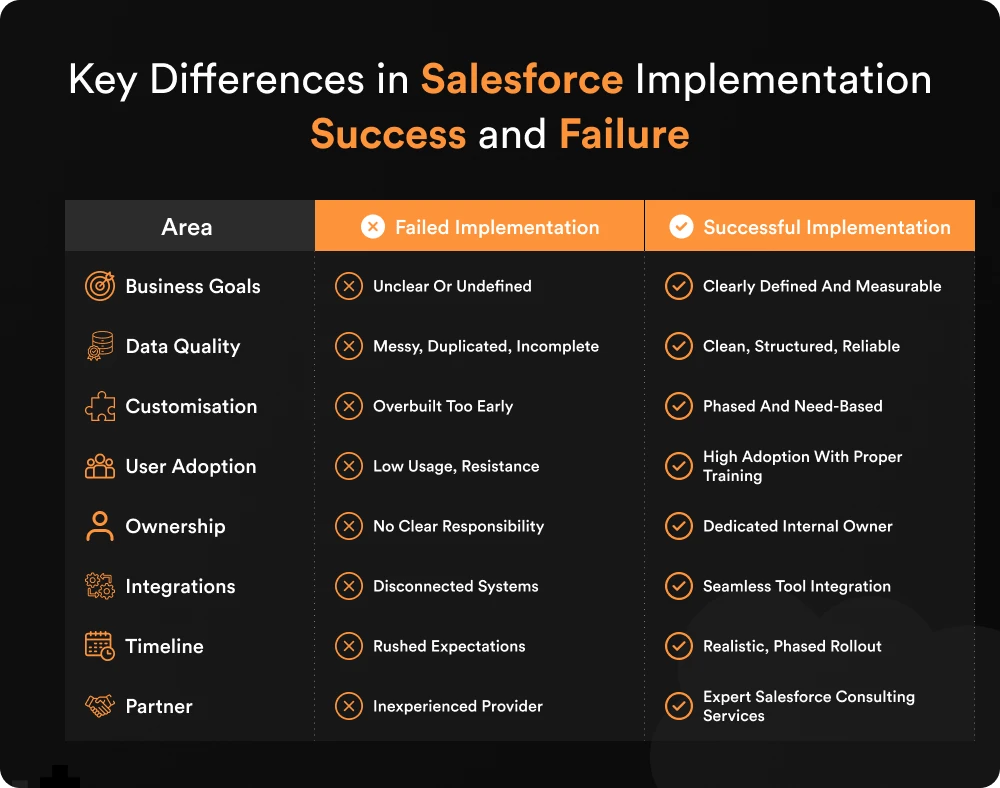
1. No Clear Business Goals
A lot of implementations start with “we need a CRM” rather than a clear reason why. Without defined outcomes, it’s hard to measure success or make the system useful. Start by linking Salesforce to specific business goals, not just features.
2. Poor Data Quality
Data migration often gets rushed. Old, incomplete, or duplicated data gets pulled in. Once that happens, trust in the system drops quickly. Cleaning and structuring data before migration makes a big difference.
3. Over-Customisation Too Early
It’s tempting to build everything upfront. Automations, workflows, custom dashboards. But too much too soon can slow things down and create confusion. Starting simple and building based on real usage usually works better.
4. Low User Adoption
Even a well-built system fails if people don’t use it. If it feels complicated or unnecessary, teams go back to old habits. Training, usability, and clarity are what drive adoption. That’s where proper Salesforce consulting services become important. Not just for setup, but for making sure everything actually works in practice.
5. Lack of Internal Ownership
Once the system goes live, responsibility often becomes unclear. Without someone owning it internally, issues pile up and improvements stall. Having a dedicated CRM owner keeps things moving.
6. Weak Integration with Existing Systems
Salesforce rarely works in isolation. It needs to connect with other tools. If integrations aren’t planned properly, teams end up switching between systems. A connected setup makes the platform far more useful.
7. Unrealistic Timelines and Expectations
Some businesses expect quick results from complex setups. When that doesn’t happen, it creates frustration. Breaking the implementation into phases makes progress more manageable.
8. Choosing the Wrong Implementation Partner
Not all providers bring the same level of expertise. An inexperienced partner can lead to gaps in setup, strategy, and support. Working with experts in Salesforce Consulting in Australia usually leads to better outcomes.
Failed vs Successful Salesforce Implementation
How to Avoid Salesforce Implementation Failure?
Most Salesforce implementation problems come back to a few key areas.
- Start with a clear plan. Know what you want the system to achieve.
- Get your data in order before anything else. It saves a lot of trouble later.
- Focus on the people using the system. If it’s not easy to use, it won’t be used.
- And don’t try to do everything at once. A phased approach gives you room to adjust and improve.
The Role of a Salesforce Consulting Partner
This is where things often turn around. A good partner doesn’t just set up Salesforce. They guide how it should be used. Working with a team that offers Salesforce Consulting in Australia also helps with local business context, compliance, and communication. More importantly, they stay involved after launch. That’s where real optimisation happens.
🎧When Salesforce Doesn’t Deliver: Mid-Market Lessons from Australia

Salesforce often underperforms in Australia’s mid-market not because of the platform itself, but due to unclear business goals, weak planning, and poor data readiness at the start of the project.
As the system goes live, low user adoption and disconnected workflows usually become the real issue, leading to frustration and underused CRM capabilities across teams.
In this episode, we break down what typically goes wrong in real implementations and the practical fixes that help improve alignment, adoption, and long-term ROI.
Wrapping it up

Salesforce implementation failure isn’t as dramatic as it sounds. Most of the time, it’s a slow drop in value rather than a complete breakdown. But it doesn’t have to be that way. With the right planning, realistic expectations, and proper support, Salesforce can do exactly what it’s meant to do. Simplify processes and support growth.
Frequently Asked Questions (FAQs)
Most fail due to poor planning, unclear goals, low user adoption, and bad data quality.
Lack of strategy, weak data, poor training, and choosing the wrong implementation partner.
It leads to inaccurate insights, low trust in reports, and reduced system usage.
By planning properly, cleaning data early, focusing on adoption, and working with experienced partners.
Yes, especially for better implementation, local expertise, and long-term system optimisation.