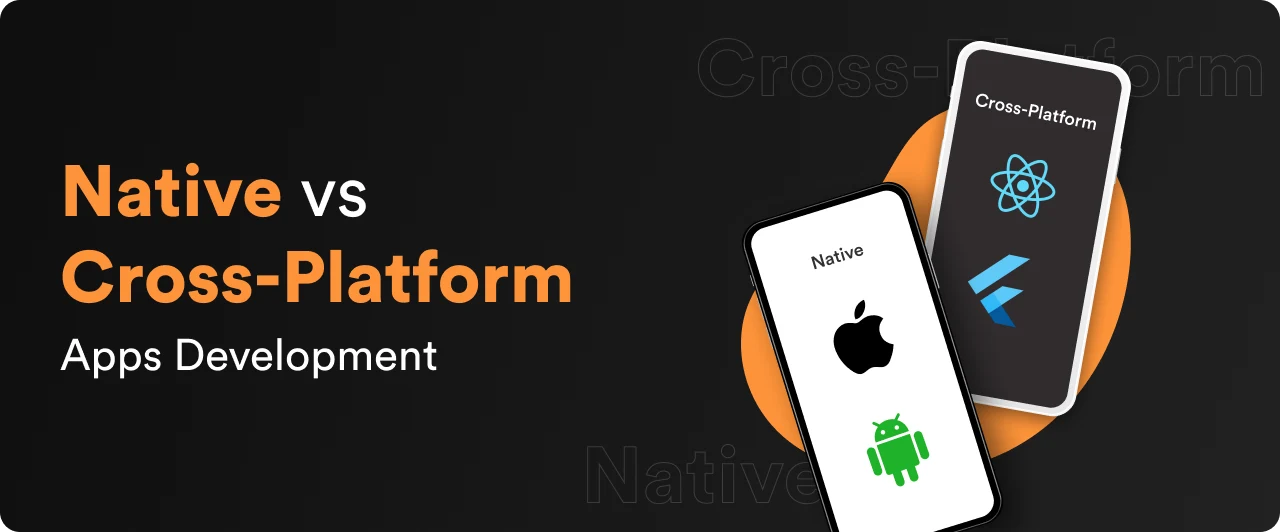
Building a mobile app is a significant commitment. You need to put in time, money, and resources. But long before you launch, one decision determines how the rest of your project unfolds. What’s that? Native, or cross-platform approach!
Most businesses treat this as a technical conversation. It is not. It affects what you spend, how fast you launch, and how your app holds up under real usage. The platform also determines the long-term maintenance costs. Get it wrong early, and you feel it for years.
There is no single correct answer. What works for a fintech startup in Sydney looks nothing like what works for a hospitality business rolling out a booking platform. The right call depends on your product, your users, and where your business is actually headed.
Two Approaches. Very Different Realities.
Businesses making smart choices in 2026 are not picking sides based on what is trending. They are looking at what their product genuinely requires and working backwards from there.
Native App Development
Native apps are built for one platform at a time. iOS runs on Swift or Objective-C. Android runs on Kotlin or Java. Because everything is purpose-built for that environment, the app runs tight, with faster animations, direct hardware access, stronger security, and snappier response times.
That level of precision matters in specific industries. A fintech platform handling live transactions cannot absorb performance gaps. A healthcare app with compliance obligations needs deep device-level control. A graphics-heavy game simply cannot afford to cut corners on speed.
The trade-off is real, though. You are building two products, not one. Two codebases to manage. Two sets of updates every time something changes. More time. More cost.
Native makes sense when:
- Security and compliance are non-negotiable
- The app is graphics-heavy or processes data in real time
- Deep hardware integration is a core requirement
- You are building enterprise-grade mobility solutions
Cross-Platform App Development
Cross-platform flips the model entirely. One codebase runs on both iOS and Android. Frameworks like Flutter, React Native, and .NET MAUI have matured significantly. The performance gap that once made cross-platform a risky bet has narrowed to the point where it is simply not a concern for most business applications.
A service booking app, a retail platform, an MVP being tested with early users — none of these need to push hardware to its absolute ceiling. They need to work well, launch on time, and improve based on what real users actually do.
That is where cross-platform consistently delivers.
Cross-platform makes sense when:
- Speed to market is a priority
- Budget efficiency matters
- You are launching an MVP or testing a new idea
- The app serves standard ecommerce or service functions
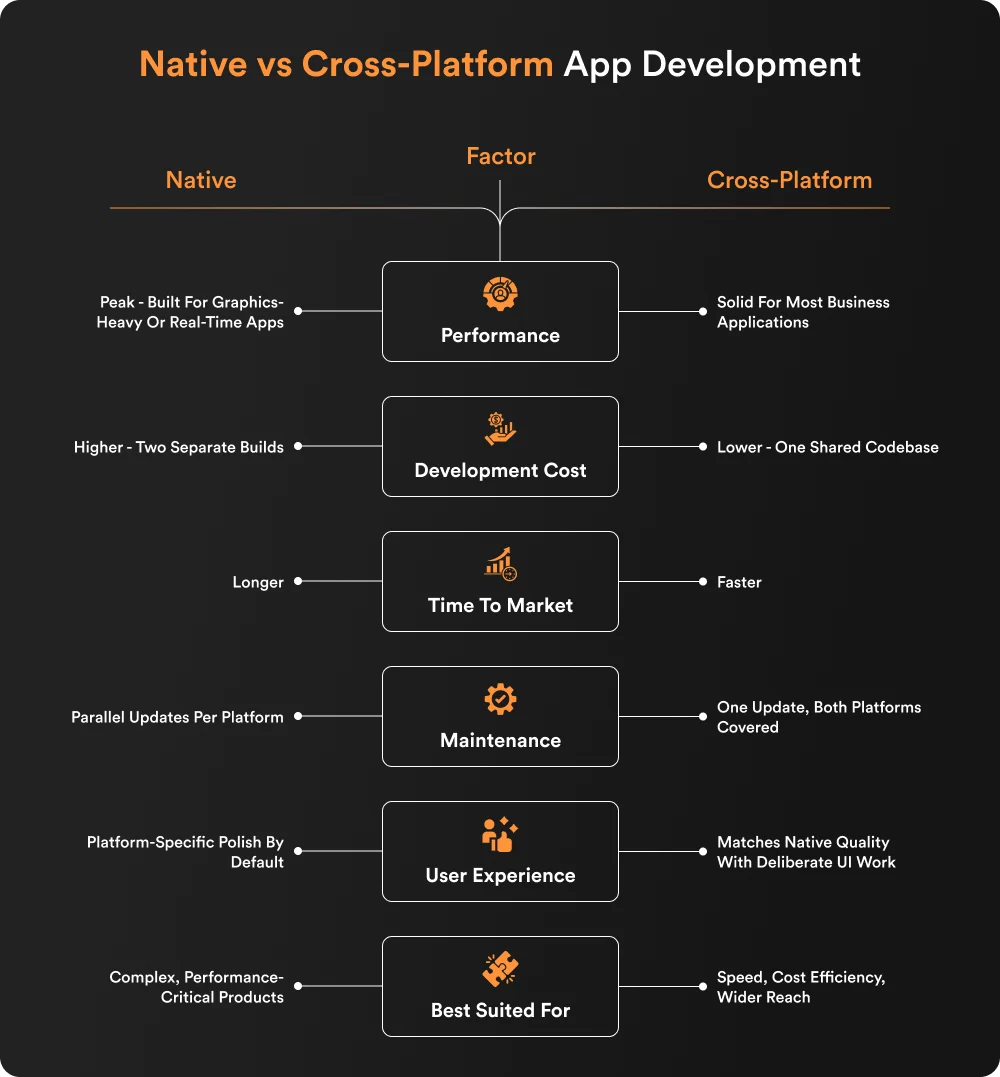
Native vs Cross-Platform: Direct Comparison
What Australian Businesses Are Actually Doing?
Cross-platform is gaining real ground across Australia — particularly in retail, hospitality, logistics, and professional services. These sectors move fast. They cannot afford lengthy build cycles when market conditions shift, or a competitor launches something new overnight.
A lot of these businesses are engaging a mobile app development company in Sydney early — not to hand the project over blindly, but to pressure-test their thinking before locking in an approach. That conversation upfront saves a lot of expensive course-correcting later.
Financial services and healthcare still lean native. The compliance requirements and integration demands in those industries make it the pragmatic choice. Not the premium option chosen out of habit — the right fit for what the product actually needs to do.
How to Pick the Right Approach?
There is no formula here, but there is a sensible sequence.
Start with your goals.
Are you validating a concept or scaling something with a proven user base? An MVP needs speed above almost everything else. A mature, complex product may justify the native investment.
Get specific about features.
If biometrics, real-time data processing, or deep hardware access are core to what your app does — not nice-to-haves, but core — native is likely the right call.
Be straight about the budget and timeline.
Cross-platform reduces both without sacrificing meaningful quality for most use cases. Choosing it for cost efficiency is not cutting corners. It is making a sound business decision.
Think beyond launch day.
Where does this app need to be in three years? Build for that version of your business, not just the one that exists today.
Talk to someone technical before you commit.
A good mobile app development services partner will lay out the real trade-offs for your specific product — not a generic pitch for one approach over the other.
🎙️ Native vs Cross-Platform Apps in 2026

Building a mobile app is not just a technical choice. The decision between native and cross-platform affects cost, speed to market, performance, and long-term maintenance. In this episode, we break down when each approach makes sense and what businesses are actually choosing in 2026. If you want to launch smarter and avoid expensive rebuilds, this conversation will help you decide with confidence.
The Bottom Line

The native versus cross-platform question does not have a trending answer. It has the right answer for your business — and those two things are rarely the same.
Work with a mobile app development company in Sydney that asks hard questions about your requirements and gives you an honest answer to a sales pitch. That conversation is often what separates a successful product from an expensive lesson.
Frequently Asked Questions (FAQs)
Ask what your app needs to do and how fast you need it done. For performance-heavy and sensitive data handing apps native is good. If you are launching an MVP or running a service-based app, cross-platform is ideal.
Cross-platform development tends to cost less upfront and over time. One codebase means one set of developers, one round of testing, and one update cycle when something changes. Native requires separate iOS and Android builds at every stage. That adds up quickly, especially once the app is live and needs ongoing work.
Speed and simplicity, mostly. You build once and cover both platforms. Updates are faster to roll out. Maintenance is less of a headache. For businesses that need to move quickly, cross-platform app development removes a lot of the friction that slows native projects down.
A few reasons. Development costs are more predictable. Timelines are shorter. And the frameworks have matured enough that performance is similar to native applications.