
Introduction
Consumers don’t just buy more stuff online now. They’ve completely flipped how they approach shopping. Fast delivery isn’t negotiable. Personalised recommendations are expected. And mobile? That’s not an extra feature anymore, it’s the whole game.
The retail battlefield got messy. But some are thriving. What’s their secret? They actually invested in proper tech infrastructure instead of just talking about it.
Plenty of smart retailers teamed up with specialists who offer web app development services and Shopify app development services. 2026 isn’t some distant horizon. Let’s find out the ecommerce trends for next year.
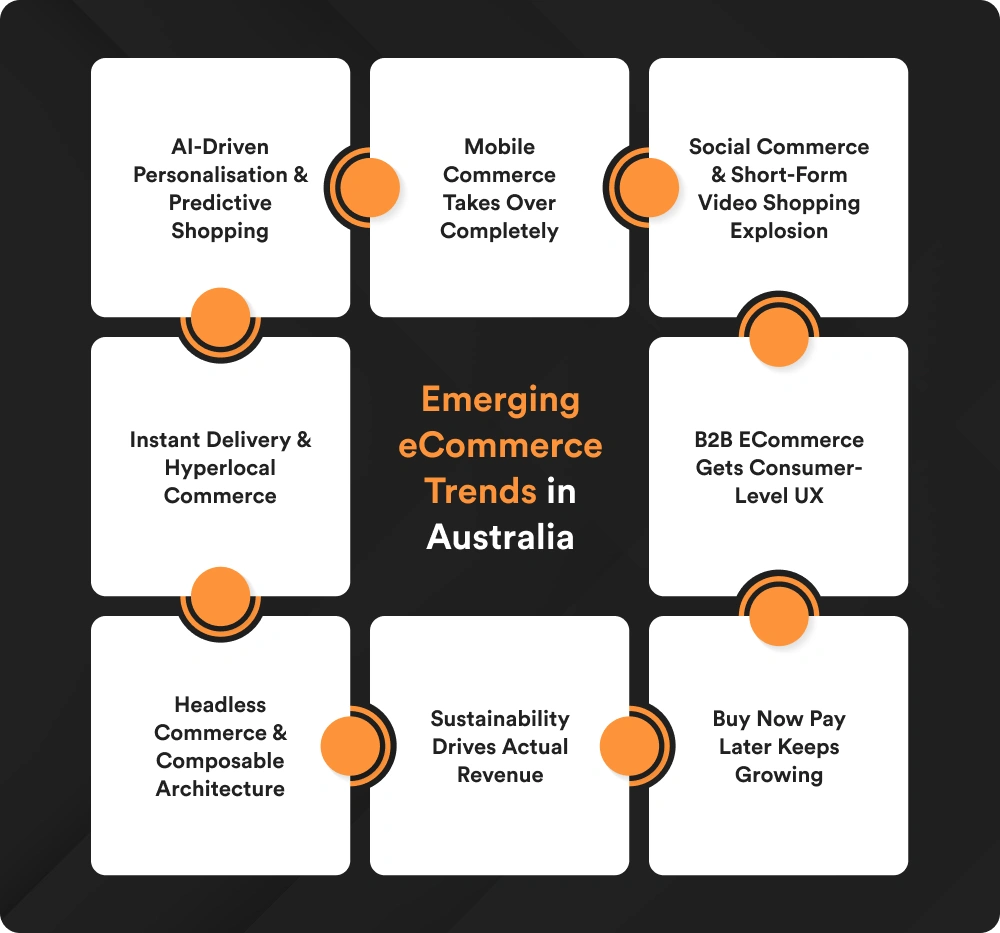
Trend 1: AI-Driven Personalisation & Predictive Shopping
AI watches everything shoppers do. Then it gets good at predictions. Someone browsing trail running shoes? The system suggests waterproof socks and energy gels. Some retailers are even testing dynamic pricing now.
Prices shift based on how badly someone wants the product. Sounds sketchy, but it’s becoming normal. This tech isn’t cutting-edge anymore. It’s basic equipment.
Trend 2: Mobile Commerce Takes Over Completely
Here’s the stat that should wake everyone up: 70-80% of Australian purchases will happen on phones by 2026.
Not tablets. Not desktops. Phones.
Watch people shop these days. Scrolling during their morning train ride. Adding items to cart during lunch. Checking out while “watching” Netflix. The phone never leaves their hand.
Slow mobile sites are bleeding money. Every extra second of load time costs sales. Clunky checkout screens? Cart abandoned, browser closed, never coming back.
Progressive web apps hit the sweet spot. They feel like real apps but don’t need downloads. No waiting for app store approvals. No eating up storage space. Just smooth, fast shopping that works.
Smart retailers partner with Shopify app development services to build these experiences. The kind that feel natural. The kind that actually convert browsers into buyers.
Mobile-first stopped being strategy talk. It’s survival mode now.
Trend 3: Social Commerce & Short-Form Video Shopping Explosion
TikTok Shop is going absolutely wild. Instagram Shopping won’t stop expanding. YouTube Shorts makes people buy things they didn’t know existed five minutes ago.
The secret sauce? Trust.
People believe creators they follow. A 30-second demo feels more honest than a polished ad. The recommendation comes across as genuine advice, not a sales pitch.
This isn’t just teens buying makeup either. B2B buyers are doing the same thing. LinkedIn experts showcase industrial equipment. YouTube demos reach procurement managers. The trends are starting to look a lot like consumer behaviour.
Search engines still matter, sure. But they’re not where discovery happens anymore. Social video took that crown.
Trend 4: B2B eCommerce Gets Consumer-Level UX
Business buyers hit their breaking point with garbage ordering systems.
Think about it. They use Amazon at home. Everything’s smooth. Three clicks and done. Then Monday morning hits and they log into their supplier portal. Forms from 2008. “Call us for pricing” messages everywhere. The contrast is painful.
Modern B2B platforms finally caught up:
- Self-service ordering that doesn’t require a phone call
- Bulk pricing that shows up automatically
- Real-time stock levels (not “call to check”)
- Mobile ordering for people actually doing their jobs
Building this stuff needs serious technical skills. Most distributors partner with companies offering web app development services to create workflows that match their specific chaos.
That “call us to order” approach? It’s dying. Finally.
Trend 5: Buy Now Pay Later Keeps Growing
BNPL got hammered in the news. Regulations. Debt concerns. Analysts predicted its death.
They were completely wrong.
Australians love payment flexibility. Breaking a $600 purchase into four payments removes the mental barrier. It just feels easier, even when the math is identical.
Younger shoppers pick BNPL over credit cards every time. They understand the terms. They know what they’re doing.
The categories seeing the biggest impact? Electronics. Luxury fashion. Furniture. Anything expensive where the sticker shock normally kills conversions.
Retailers keeping BNPL visible at checkout are seeing real conversion bumps. It’s not going anywhere.
Trend 6: Sustainability Drives Actual Revenue
Gen Z and Millennials fact-check everything about sustainability.
They read the fine print on packaging. They verify carbon-neutral shipping claims. They investigate sourcing transparency. Empty marketing promises get destroyed on social media within hours.
Retailers actually responding to this (not just pretending):
- Showing carbon footprints right on product pages
- Offering eco-friendly packaging at checkout
- Providing carbon-neutral shipping as a real option
- Displaying verified sustainability badges (not made-up ones)
The business reason is simple. Products with legit sustainability credentials convert better. Period.
Trend 7: Headless Commerce & Composable Architecture
Traditional ecommerce platforms glue everything together. Change one thing and risk breaking three others. Customisation becomes a nightmare. Sites run slow. Flexibility doesn’t exist.
Headless architecture separates frontend and backend components. Benefits show up fast—sites load way faster, global expansion gets easier, custom storefronts happen without rebuilding everything.
Shopify Plus merchants are jumping on this approach quickly. They partner with web app development services to build unique front-ends while keeping Shopify’s solid infrastructure.
Trend 8: Instant Delivery & Hyperlocal Commerce
Patience vanished from online shopping.
Metro shoppers want stuff in hours, not days. One to two-hour delivery is becoming standard. Next-day delivery already feels slow. Same-day is barely acceptable.
Small retailers can’t beat Amazon’s product range. But they can crush Amazon on speed for local items. A neighborhood store promising 90-minute delivery? That wins.
Click-and-collect deserves its own shoutout. Why pay delivery fees when the store is ten minutes away?
Hyperlocal commerce is keeping independent retailers alive and competitive.
Key Capabilities Australian Retailers Need
Capability | 2026 Priority Level | How Retailers Can Implement It |
AI Personalisation | High | Use AI engines + integrate with web/app platforms |
Mobile-First UX | Critical | Invest in PWAs or Shopify app development services |
Social Commerce | High | Sell via TikTok Shop, Instagram Shop |
Headless Commerce | Medium-High | Adopt a composable architecture with web app development services |
Sustainability Features | High | Add eco badges, carbon-neutral options |
Instant Commerce | Critical | Set up local delivery hubs |
Prepare for 2026 Ecommerce Industry Trends
Retailers dominating 2026 are building capabilities right now.
Find partners offering web app development services who get both consumer markets and b2b ecommerce trends. The lines between these markets are blurring fast.
🎧 Podcast: eCommerce Trends Shaping Australia 2026!

Explore the eight major eCommerce shifts Australian retailers must act on: AI personalisation, mobile-first UX, social commerce, BNPL, sustainability, headless stacks and instant delivery. Practical tactics to prepare your store for 2026.
🎙 Press play and avoid costly mistakes.
Frequently Asked Questions (FAQs)
AI personalisation is changing product recommendations completely. Mobile commerce is taking over as the main channel. Social commerce through TikTok and Instagram keeps exploding. And sustainability features actually affect whether people buy or bounce.
It’s basically everything now. Around 70-80% of purchases happen on phones. Most people browse and buy exclusively on mobile. Store doesn’t work on phones? Store doesn’t work.
Yeah, absolutely. High-ticket items like furniture and electronics see massive conversion bumps when BNPL is available. Younger shoppers love it.
The difference is pretty dramatic. Stores using decent AI systems see conversions jump noticeably. Customers buy more often when recommendations actually match their interests instead of random stuff. The system learns shopping patterns and gets sharper over time. Setup costs money upfront but pays back surprisingly fast.
Already happened. People discover products on TikTok now, not Google. Short videos from creators they trust drive massive impulse buying. The whole “see it, want it, buy it” cycle compresses into under a minute. Traditional product search is becoming less relevant every month.
Way more than even three years ago. Younger buyers check packaging materials and carbon footprints before checkout. They research whether brands actually do what they claim. Fake green marketing gets absolutely destroyed on social media. Real sustainability efforts build genuine loyalty that lasts.
Get mobile working properly first. Like actually properly—fast load times, smooth checkout, the whole thing. Then layer in AI personalisation if budget allows. Speed up delivery options wherever feasible. Build on tech that can scale with growth through solid web app development services. Stop planning and start building.