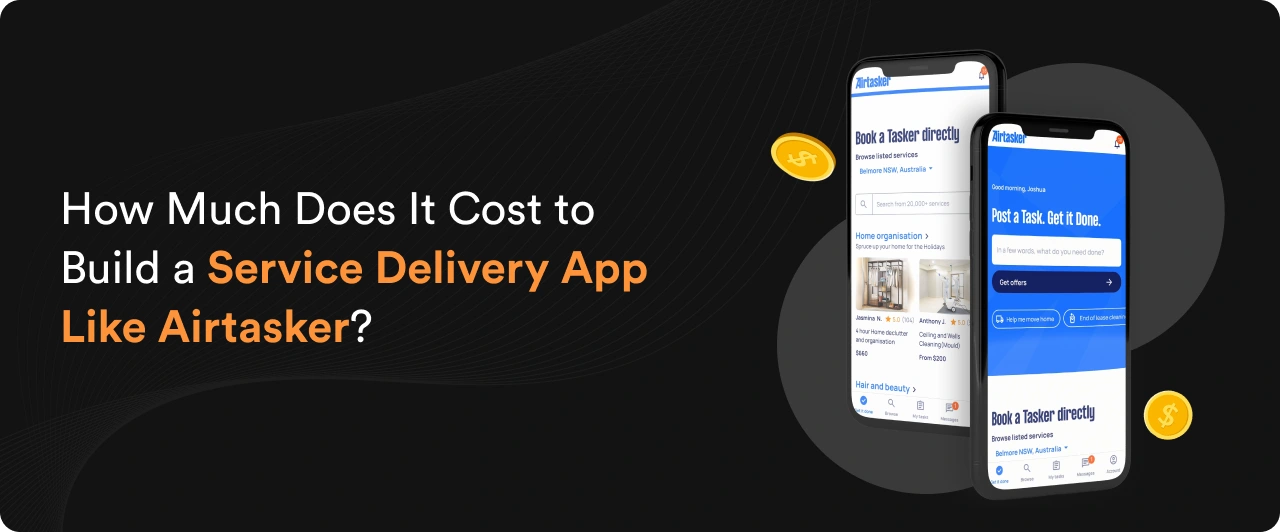
People often talk about Airtasker as if it’s just another marketplace app. In reality, it’s closer to an operating system for services. It manages trust between strangers, money movement, availability, location, and timing—all while trying to stay invisible to the user.
That’s why the cost of building a service delivery app like Airtasker is rarely straightforward. The real question isn’t how much it costs? It’s how much are you trying to solve in version one?
Why Apps Like Airtasker Are Harder Than They Appear?
On the surface, the flow looks simple. Someone posts a task. Someone else accepts it. The job gets done. Payment follows.
Behind that flow, there is a two-sided product. You are creating a tool for customers and service providers simultaneously. The motivations, concerns, and behaviours of these two groups differ. The application must deliver speed and safety, structure and flexibility, and human judgment and automation.
This complexity is what drives cost in Service Delivery App Development, not the screens you see in a demo.
The Features That Actually Define the Budget
Dual User Roles
A service delivery app needs clearly separated experiences for task posters and taskers. That means different onboarding flows, dashboards, permissions, and notifications. The more tailored these experiences are, the more development effort is involved.
Task Creation and Discovery
Posting a task sounds easy until you factor in categories, budgets, locations, deadlines, attachments, and visibility rules. Matching the right task to the right service provider is one of the most iterated parts of the product.
Messaging and Real-Time Updates
Once users start talking inside the app, expectations change. Messages need to be instant. Notifications need to be reliable. Failures here are very visible—and very damaging to trust.
Payments, Escrow, and Payouts
This is where many first-time founders underestimate cost. Handling payments isn’t just about charging a card. It involves holding funds, releasing them conditionally, issuing refunds, and paying providers on time. Every edge case needs to be handled cleanly.
Ratings, Reviews, and Trust Signals
Reviews, ratings, and basic dispute handling aren’t “nice to have.” They’re what make strangers comfortable working together. These systems also influence search results and provider visibility, which adds another layer of logic.
So, How Much Does It Really Cost?
Instead of a single number, it’s more useful to look at cost in tiers.
Typical Cost Breakdown for a Service Delivery App
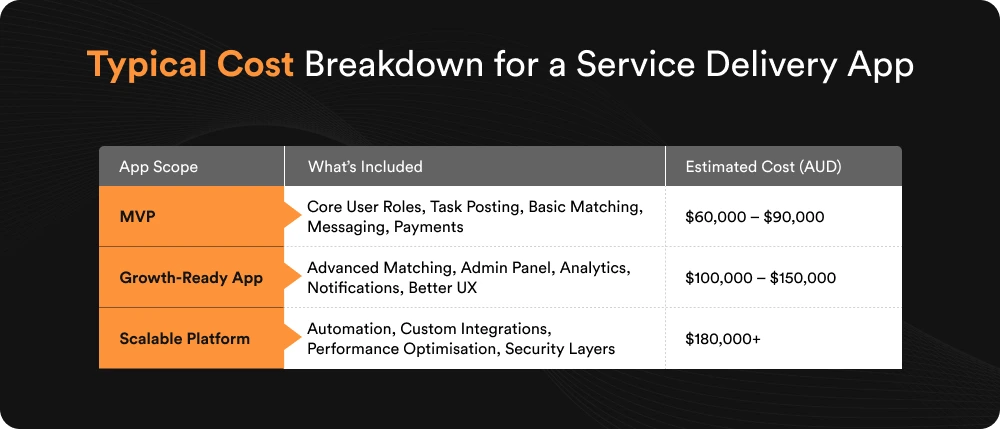
These ranges reflect real trade-offs. Every additional feature adds logic, testing, and long-term maintenance, not just development hours.
What Else Pushes the Cost Up (or Down)?
Platform Decisions
Building native applications for both iOS platform and Android increases cost. Many teams reduce early spend by choosing cross-platform frameworks or launching on one platform first.
Design Expectations
A functional interface costs less than a polished, consumer-grade experience. Apps like Airtasker didn’t start perfect—they improved through iteration.
Backend and Admin Tools
Admin dashboards, moderation tools, and reporting often get added late, but they shouldn’t. These systems are essential for running the marketplace and usually require more work than expected.
Post-Launch Reality
Launch isn’t the end. Bug fixes, performance tuning, and feature updates are ongoing. A reliable mobile app development company will plan for this instead of treating it as an afterthought.
How Long Does Development Usually Take?
A lean MVP generally takes 3 to 4 months, assuming decisions are made quickly and scope is controlled.
A more complete version with stronger UX, admin tooling, and automation usually takes 5 to 7 months.
Large service marketplaces never really stop developing. They evolve based on real usage, not assumptions made at the start.
Why the Development Partner Matters More Than the Stack?
Cost overruns rarely happen because of technology. They happen because the wrong things are built too early.
Teams with experience in marketplace products will challenge assumptions, prioritise correctly, and help you avoid expensive mistakes. For Australian businesses, working with a team of mobile app development in Sydney often helps with local compliance, payment preferences, and user expectations.
🎙️ The Real Cost of Building a Service Delivery App Like Airtasker
F

From dual user roles to escrow payments and trust systems, this episode explains why service delivery apps are harder than they look. Learn how smart prioritisation shapes both cost and product success.
Invite Clarity With Right Techies!
For businesses exploring Service Delivery App Development, the smartest investment is knowing what to build now, what to defer, and what will actually move the product forward.
Frequently Asked Questions
Most projects start around AUD 60,000 for an MVP and can exceed AUD 200,000 for a fully scalable platform. The final cost depends on features, platforms, and long-term goals.
Dual user roles, task posting, messaging, secure payments, notifications, and reviews are essential. Admin tools become critical as the platform grows.
An MVP typically takes 3–4 months. More advanced versions take 5–7 months or longer, depending on complexity.