Select the wrong mobile app framework, and you will waste months on re-creation of things that could have worked within the first week. Get it right, and you are shipping updates when competitors have not even debugged yet.
In 2026, users expect apps that feel native on every device. Investors want proof you can move fast. That’s why choosing the best mobile app frameworks becomes make-or-break when you’re racing to launch or scale into new markets.
This guide cuts through the noise. We’ll look at frameworks that actually work for Australian startups based on real performance numbers, what developers cost locally, and which tools help you ship without burning cash.
Why Framework Decisions Matter More Than You Think?
Australian startups work with constraints other markets don’t face. Fewer talent pools imply that you are not always able to get that expert you require. Strict budgets imply that all money matters. The thing is that global competition presupposes that your applications should punch above their weight.
Here’s what changes based on your framework pick:
- Cross-platform tools cut development time by 30-40% versus building native. Flutter developers in Sydney cost around $95-130k a year.
- React Native developers earn $110-145k. Some frameworks need constant patching. Others just work. And when your app takes longer than 3 seconds to load, you lose about a third of users before they even see your product.
The majority of founders pick up whatever design is suggested by their developer friend. Better approach? Find the tool that suits your product, your team and where you are aspiring to be in 18 months.
Flutter Works When You Need Speed and Polish
Flutter’s become the default best mobile app framework for Australian startups building quality apps fast. Google built it, and companies from Alibaba to BMW trust it in production.
Flutter compiles straight to native code. No janky bridge slowing things down. Apps feel responsive right away. The hot reload feature is brilliant, change something, see it instantly. No waiting around for rebuilds.
The widget system makes custom interfaces easier than you’d expect. If you’re building fintech, health tech, or anything consumer-facing where design matters, Flutter handles it well.
Melbourne’s Brighte rebuilt their loan management app in Flutter and dropped their codebase by 40%. Went from 8 months of development to 5. Launched iOS and Android at the same time instead of months apart.
React Native for Teams Already Running JavaScript
Already built your backend in Node.js? Using React for your web app? React Native becomes obvious. It’s the second best mobile app framework for teams that want to stick with JavaScript.
Facebook made React Native to solve their own problems scaling mobile. It’s matured a lot. Shopify runs on it. So does Microsoft Teams.
Finding React Native developers in Sydney or Melbourne beats trying to source Flutter specialists or native iOS/Android experts. When you need to hire your first mobile developer or scale the team quickly, that availability helps.
The community’s massive too. Hit a weird bug? Someone’s already figured it out and posted the fix. For early-stage teams without senior mobile people, that safety net matters.
What Cross-Platform Actually Costs?
Numbers matter when you’re watching runway. Here’s the breakdown:
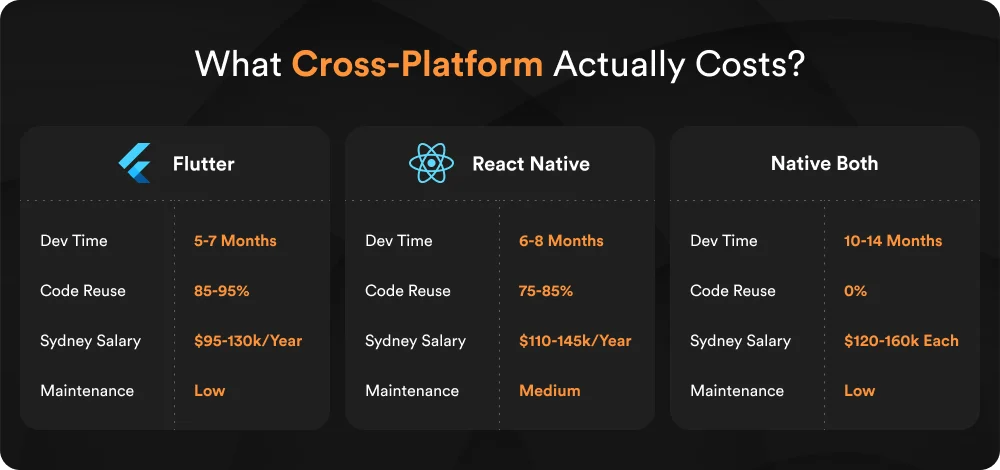
A Sydney mobile app development company in Sydney told us their startup clients save 35-45% on initial development using Flutter or React Native versus building separate native apps.
Maintenance costs differ too. Flutter needs updates less often since it compiles to native. React Native requires more attention as the JavaScript ecosystem moves fast.
When Native Still Wins?
Cross-platform dominates startup conversations now, but native hasn’t died. Some situations demand it.
Games, AR/VR stuff, and apps doing heavy computation still need native. Direct hardware access matters when every frame counts.
Perth’s Rescape builds VR training software. They went Swift for iOS and Kotlin for Android specifically because their 3D rendering couldn’t handle any performance overhead. Extra dev time paid off in how smooth everything feels.
Apps that really dig into platform-specific features, advanced camera work, biometric authentication, health data sometimes hit walls with cross-platform tools. Native gives you everything immediately.
Trade-off? Double the development time, double the developer costs. For most Australian startups early on, that math doesn’t work.
Flutter vs React Native Right Now
Both work. Right choice depends on your situation.
Go Flutter if you need a polished MVP fast, design matters a lot to your product, you’re starting fresh without existing JavaScript code, or you want predictable performance without constant debugging.
Adelaide’s HealthEngine rebuilt their patient booking with Flutter. App got 40% smaller and scrolling got noticeably smoother.
Go React Native if your team already knows JavaScript inside out, you’re iterating like crazy and pushing updates constantly, you want access to the biggest mobile dev community, or hiring developers beats squeezing out marginal performance gains.
Getting It Built
Most Australian startups hit this question: build in-house or work with an agency?
Agencies get you experienced developers immediately. No hiring risk. Faster to market. Scale resources up or down as needed. A mobile app development company in Australia brings experience from dozens of projects, patterns that worked, mistakes to avoid.
In-house keeps everything internal. Faster iteration once you’re set up. Better long-term economics if you’re building multiple products. Direct control over what gets built.
Smart move? Start with an agency to ship your MVP, then hire a developer or two to maintain it. Gets you to market fast while building internal knowledge.
Look for agencies with real work in your framework, case studies from similar-stage startups, transparent pricing, and clear communication.
Launch Strategy
Pick your framework. Then execute.
Spend 2-3 weeks on a proof of concept. Build one key feature. Validates your technical assumptions. Discovering framework problems after two months hurts.
MVP takes 3-5 months. Core features only. Ship something users can actually test. Build your coding standards and deployment setup now.
Don’t over-engineer early features. Don’t ignore platform design rules for iOS and Android users expect different things. Don’t skip testing on real devices. Don’t build features before you know people want them.
Start Building
The best mobile app frameworks in 2026 let Australian startups compete globally without torching their runway. Flutter and React Native both are both cheaper and much faster to develop.
Find a match tool with the skills of your team, the requirements of your product and your directions. In the majority of the startups, either Flutter with design-intensive apps or React Native with JavaScript developers will win.
Framework matters, but execution matters more. Well-built app in any modern framework beats poorly executed native every time.
The development of the Mobile app in Australia does not concern chasing all the shiny new things. It involves choosing tools that enable one to construct quickly, learn how other people use them, and refine them to what people actually desire.
🎙️ Podcast: Choosing the Best Mobile App Framework for Your Startup

In this episode, we talk about how picking the right mobile app framework can save startups months of development. We share what actually works for Australian teams and where founders often get it wrong.
Ready to Ship Your App?

A mobile app development company in Australia like VT Digital brings real expertise in Flutter, React Native, and native development. They’ve worked with SMBs and enterprise companies across Australia, shipping apps that balance performance, design, and efficiency.
Frequently Asked Questions (FAQs)
Flutter and React Native lead. Flutter works best for design-focused apps needing smooth performance. React Native suits JavaScript teams wanting faster hiring.
Compared to single native applications, cross-platform saves 35-45% of start-up development. Code reuse is 85-95% with development decreasing to 5-8 months 10-14 months.
Flutter edges ahead for new projects, better performance, faster development. React Native is still strong for JavaScript teams and rapid iteration.