















Online retail in Australia is changing at a rapid rate which is catching most business owners off guard. Competitors have moved past basic chatbot experiments. They're now deploying AI systems that anticipate customer needs before those customers begin their search.
The AI in ecommerce is empowering teams with out-of-reach capabilities before. Think shopping experiences that become personalized to your taste, inventory systems that function like themselves and customer insights that in the past only entire analytics departments accomplished. Smart retailers from Sydney to Perth are putting AI to work.
The real question is not whether or not to adopt AI. It's how quick you are to put it in place before you lose ground to competitors who've already begun.
Where Australian Ecommerce Stands Right Now?
The data tells a clear story. Australian online retail topped $65.5 billion in 2024. Retailers who use AI powered systems convert up to 30-40% more visitors compared to those that have used traditional means. This performance gap matters. It separates those businesses which are growing from those that are struggling to retain position.
Large retailers such as The Iconic and Chemist Warehouse have integrated everything with AI in their processes. They use it to deploy product recommendations, fraud prevention, and customer service.
Top AI Use Cases Reshaping Ecommerce
1. Personalisation That Actually Converts
Generic product displays no longer perform. Current AI examines individual browsing patterns, purchase history, and shopping times. It then surfaces products each customer is most likely to buy.
Consider Showpo, an Australian fashion retailer. Their average order value increased 23% when it used AI personalisation. The system was able to predict that customers who bought activewear on weekday mornings were more interested in complementing accessories.
2. Chatbots That Solve Real Problems
Early chatbots struggled with basic queries. Today's versions handle complex questions, process returns, and recommend products based on conversation flow.
A Sydney based homewares retailer reduced their customer service costs by 45% whilst slashing response times from hours to seconds. Their AI chatbot is able to resolve 70% customer enquiries on its own. Staff concentrate on complex issues requiring human judgement.
3. Inventory Management Through Forecasting
Running out of bestsellers during peak periods damages revenue. Overstocking slow-moving items wastes capital. AI addresses both by forecasting demand with notable accuracy using multiple signals.
Brosa: Brosa is a Melbourne retailer specializing in furniture. Brosa uses AI to determine demand for hundreds of different products. Their system factors in weather patterns, local events, purchasing history, and seasonal cycles. Popular items remain available whilst warehouse expenses dropped 18%.
4. Dynamic Pricing That Protects Margins
Static pricing leaves profit on the table. AI adjusts prices continuously based on demand levels, competitor pricing, inventory position, and customer segments.
Airlines and hotels have operated this way for years. Ecommerce is now following. A Brisbane retailer working with Magento development services adopted dynamic pricing and saw profit margins rise 12% without sacrificing customers to competitors.
5. Visual Search That Understands Products
Customers photograph items they like. Your AI locates similar products in your inventory immediately. This capability has shifted from experimental to standard, particularly for fashion and homewares.
Kathmandu, the Australian outdoor gear retailer, integrated visual search and uncovered something notable. Customers using this feature completed purchases at three times the rate of those using text search.
6. Fraud Detection That Safeguards Revenue
Chargebacks and fraudulent transactions cost Australian ecommerce retailers millions each year. AI identifies suspicious patterns faster and more reliably than human teams whilst processing legitimate orders smoothly.
An electronics retailer partnering with a Magento development company in Sydney cut fraudulent transactions by 67% after deploying AI fraud detection. The system learned to spot risky patterns whilst approving legitimate orders that older rule-based systems would have wrongly blocked.
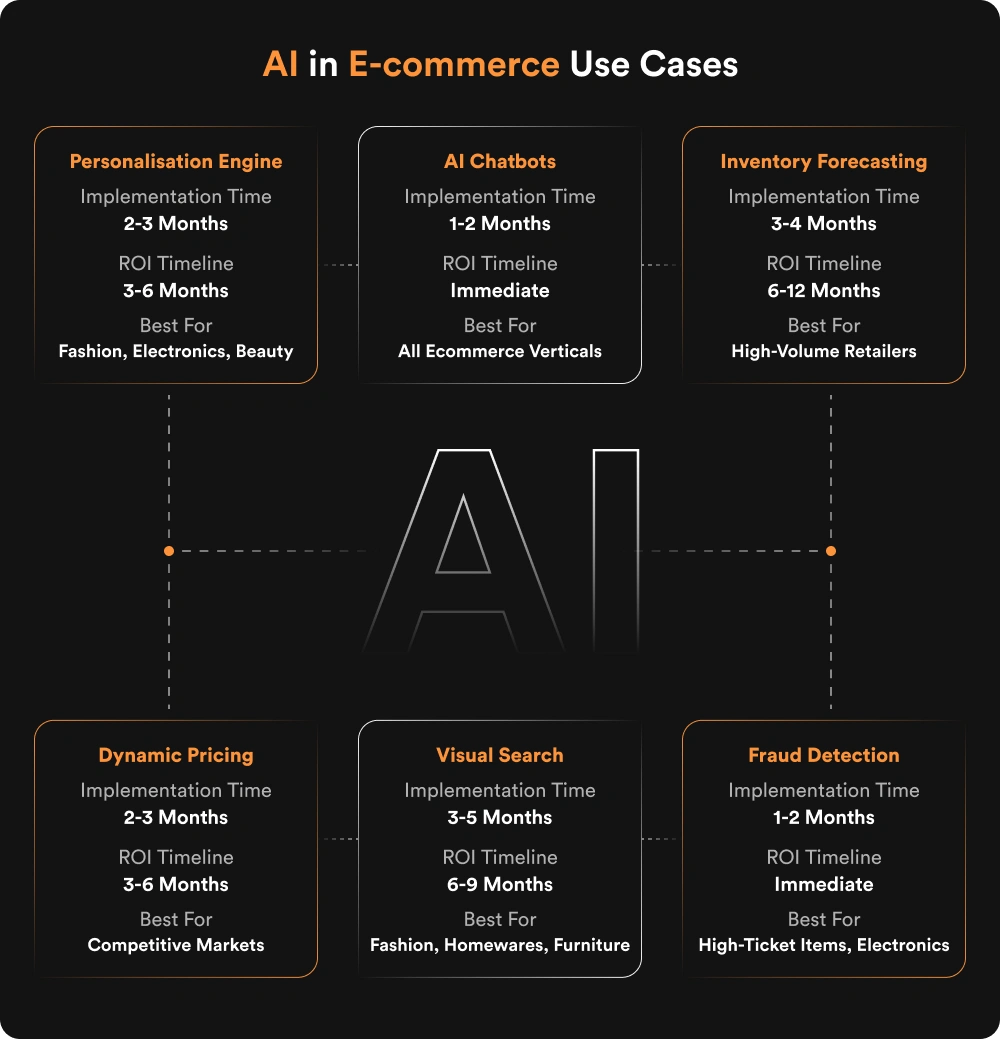
AI in E-commerce Use Cases: A Comparative Overview
Emerging Trends for 2026
Individual Shopping Journeys
Rather than simply displaying different products, AI will construct entirely different shopping experiences. Some customers receive video content. Others get detailed specifications. Some need only quick bullet points. The interface adapts automatically to individual preferences.
Advanced Voice Commerce
Voice shopping is expanding beyond reorders. Customers will discover products through natural conversations with AI assistants. The technology interprets context and makes relevant suggestions based on previous purchases and expressed preferences.
Scaled Product Content Creation
Writing unique descriptions for thousands of products consumes significant time. AI now handles this, producing SEO-optimised content that converts visitors. Early adopters using Magento development services are recording organic traffic gains around 25%.
Visible Sustainability Metrics
Australian consumers increasingly think about the environment. AI tracks and shows the carbon footprint of products, recommends eco-friendly alternatives to businesses, and businesses can meet sustainability targets with AI.
Early Customer Value Prediction
Instead of uniform treatment of customers, AI helps to identify high-value customers early in their journey. This allows for more effective allocation of marketing spend that can be concentrated where the resources spend produces the highest returns.
Mistakes That Undermine Implementation
Attempting Too Much Initially
You do not need to revamp everything at the same time. To do this, choose one of your next project use cases, the one that is more pressing, the challenge. Perfect it. Then expand systematically to other areas.
Neglecting Data Quality
AI performs only as well as its input data allows. When implementing any AI solution, you should clean your customer data, product information, and transactions information. Low quality idealize even sophisticated AI systems.
Selecting Tools Before Defining Strategy
One doesn't need advanced AI platforms to make results happen. First, set the definition of success for your business. Then identify tools built to help you to achieve those particular outcomes.
The Market Reality
The trends of AI ecommerce are still gaining ground. Retailers that are thriving in 2026 will be the retailers who implemented AI solutions now and not the retailers who are still considering their options. You don't need huge tech teams, endless budgets.
You need a development partner who understands how AI works as well as how the real world of ecommerce works. Someone who's already guided Australian businesses through this exact transformation.
The competitive advantage AI delivers is genuine, but time-limited. Each month you delay, competitors advance whilst you evaluate.
?️ AI Ecommerce Use Cases That Boost Conversions in 2026

In this episode, we discuss proven AI ecommerce use cases reshaping online retail. Learn how leading Magento development companies are helping businesses stay competitive ahead of 2026 trends.
 Press play and listen.
You Cannot Afford to Miss These Ecommerce Trends for 2026!
AI in ecommerce isn't about pursuing every emerging trend. It's about maintaining a competitive position in a rapidly shifting market.
Partner with a development team that knows Australian ecommerce inside out. VT Digital has collaborated with numerous SMBs and enterprise organisations, delivering feature-rich, efficient solutions. Let's position you ahead of them instead.
Frequently Asked Questions (FAQs)
What are the top AI use cases in ecommerce?
The most impactful applications of AI include personalisation engines of products that are relevant, intelligent chatbots that take care of customer service. These also include customer service, predictive inventory management, dynamic pricing optimisation, visual search capabilities and fraud detection tools.
How does AI personalisation boost ecommerce sales?
AI personalisation looks individually at the customer behaviour individually and usually reveals what they are, for example, what products might be relevant at the right times. Conversion rates usually rise by 30-40%. It provides shopping experiences instead of generic and triggers immediate sales, but builds customer loyalty for the long term with customer relevance.
What AI trends will shape ecommerce in 2026?
Anticipate some hyper-personalised shopping journeys which change according to individual preferences, sophisticated voice commerce capabilities. These also include artificially intelligent product content at scale, tracking of sustainability, or predictive analysis of customer lifetime equity, augmented reality shopping assistants.
Which is the best AI ecommerce development company in Australia?
VT Digital provides practical AI solutions built specifically for Australian ecommerce businesses. Their experience across both SMBs and enterprise clients means they develop scalable implementations generating measurable business results.


Senior Technical Project Manager
Dushyant Takhar is a Web App Development Expert, passionate about building robust and scalable applications. His focus is on creating innovative solutions that streamline business processes and set companies up for long-term digital success.