Introduction: Modern Accounting Software Features
Most accounting software forces businesses to change how they work. That’s backwards.
Generic tools promise simplicity but deliver limitations. They can’t handle complex transactions. They struggle with multiple currencies. Australian compliance requirements, such as GST and BAS reporting, are often added as afterthoughts.
The bigger problem? Accounting companies eventually outgrow these generic platforms. Then they’re stuck paying for features they don’t need.
Custom software development addresses these challenges. A software development company in Sydney builds systems around existing workflows, not against them. The result is software that actually earns its keep.
Custom vs. Off-the-Shelf: What's the Real Difference?
Custom accounting solutions work differently. They’re built around actual business processes.
Here’s a quick comparison:
Feature | Custom Software | Off-the-Shelf |
|---|---|---|
Flexibility | Built for exact needs | One-size-fits-all |
Integration | Seamless connections | Often problematic |
Scaling | Grows with business | Limited capacity |
Compliance | Australian tax rules built in | Generic features |
Long-term cost | Lower overall | High recurring fees |
Support | Dedicated team | Shared help desk |
The initial cost is higher with custom software development. But over five years? Custom usually wins.
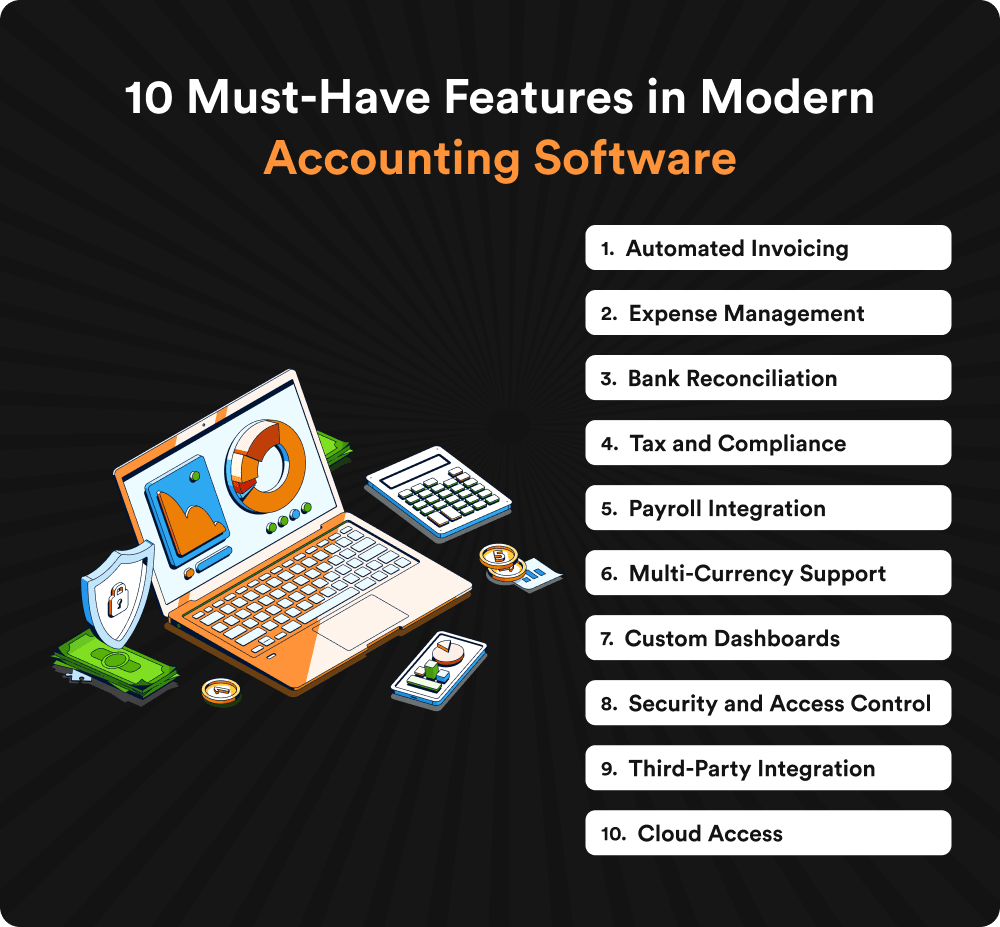
10 Must-Have Features in Modern Accounting Software
Not every feature matters equally. Focus on what actually drives efficiency.
Automated Invoicing
Manual invoicing wastes hours every week. Automated systems create, send, and track invoices without human intervention. Payments arrive faster. Errors drop to nearly zero.
Expense Management
Where does money actually go? Real-time tracking shows exactly that. Categorisation happens automatically. Approval workflows prevent unauthorised spending. Receipt scanning eliminates data entry.
Bank Reconciliation
Matching thousands of transactions manually? That’s yesterday’s problem. Automatic syncing pulls data from all bank accounts. Mismatches show up immediately. Accountants focus on exceptions, rather than routine checks.
Tax and Compliance
Australian tax requirements aren’t simple. GST calculations need precision. BAS reports have deadlines. Mistakes cost money.
Built-in compliance removes the guesswork. Calculations run automatically. Reminders prevent missed deadlines. Penalties become rare.
Payroll Integration
Employees expect accurate payments on time. Superannuation must be tracked. Fair Work regulations demand compliance.
Integrated payroll handles everything: wages, super, leave balances, and tax withholding. No separate systems. No manual transfers.
Multi-Currency Support
Operating internationally? Multi-currency features become essential. Conversions happen automatically. Reports consolidate everything into AUD. Financial clarity improves dramatically.
Custom Dashboards
CFOs need different data than accountants. Managers need different views from auditors.
Custom dashboards show each person exactly what they need. Profit and loss. Cash flow. Performance metrics. All updated in real-time.
Security and Access Control
Financial data attracts threats. Protection must be serious. Custom software development implements end-to-end encryption to safeguard everything. Role-based access means people see only what they should. Audit trails track every action.
Third-Party Integration
For best outcomes, accounting needs to connect with CRMs, inventory systems, and eCommerce platforms. Proper integration eliminates double entry. Data flows automatically. Accuracy improves across all systems.
Cloud Access
Remote work is standard now. Teams need access from anywhere. Mobile apps extend functionality to phones and tablets. Cloud deployment makes this possible without complex infrastructure. Updates happen instantly. Collaboration becomes natural.
A good software development service provider balances these features based on actual business needs.
How Custom Software Improves Daily Operations?
The benefits go beyond features. They show up in everyday work.
Time savings are massive. Automation handles repetitive tasks. Reconciliation that took days now takes hours.
Accuracy improves when humans aren’t manually entering numbers. Compliance becomes automatic rather than stressful. Teams focus on analysis instead of administration.
Real-time insights change decision-making. No more waiting for month-end reports. Problems become visible immediately. Opportunities get seized faster.
Choosing the Right Custom Software Development Partner
Features matter. But implementation matters more.
Look for experience with both software development and business finance. The best software development company Sydney will understand coding and the basics of accounting principles.
End-to-end support should encompass everything, from business analysis and design to deployment and ongoing maintenance. The relationship doesn’t end at launch.
Local expertise helps with Australian compliance requirements. GST, BAS, superannuation, and Fair Work regulations need proper implementation.
🎧 Podcast: Custom Accounting Software: Smart, Scalable & Compliant

Discover how custom accounting software transforms financial management for Australian businesses. From automation and compliance to real-time insights and scalability, learn why tailored solutions outperform generic tools and help your business save time, reduce errors, and boost efficiency.
🎙 Press play and avoid costly mistakes.
The Bottom Line
Generic accounting tools work for basic needs. But growing businesses need more.
Custom software adapts to changing requirements. It integrates with existing systems. It handles complexity without breaking. It grows without expensive migrations.
The investment makes sense when accounting becomes a competitive advantage instead of an administrative burden.

Frequently Asked Questions (FAQs)
Expect to pay between $25,000 and $80,000 AUD. The exact cost depends on complexity, number of modules, and integration requirements. More features and connections mean higher costs. But compare this to 5-10 years of subscription fees, custom often costs less overall.
Custom software fits the business perfectly. It scales without limits. Security meets actual requirements. Integration happens seamlessly. Long-term costs are lower. Support comes from people who know the specific system.
Full software development services include business analysis, UI/UX design, development, testing, integration, deployment, and maintenance. Everything from concept to launch and beyond.
Automation eliminates manual tasks. Real-time data enables faster decisions. Compliance becomes automatic. Teams spend time on strategy instead of data entry. Errors decrease dramatically.
Most projects take 3-6 months. Simple systems are faster. Complex enterprise solutions with multiple integrations take longer. Rushing creates problems. Proper development ensures reliability.