The wrong Salesforce consultant will cost you months of wasted time and over $100,000. Australian businesses throw away this kind of money on failed CRM projects all the time, usually because they didn’t ask the right questions upfront.
Here’s what happens: you can’t tell who actually knows Salesforce and who just talks a good game in meetings. Six months later, you’ve got broken integrations, a system your team won’t touch, and a massive hole in your budget.
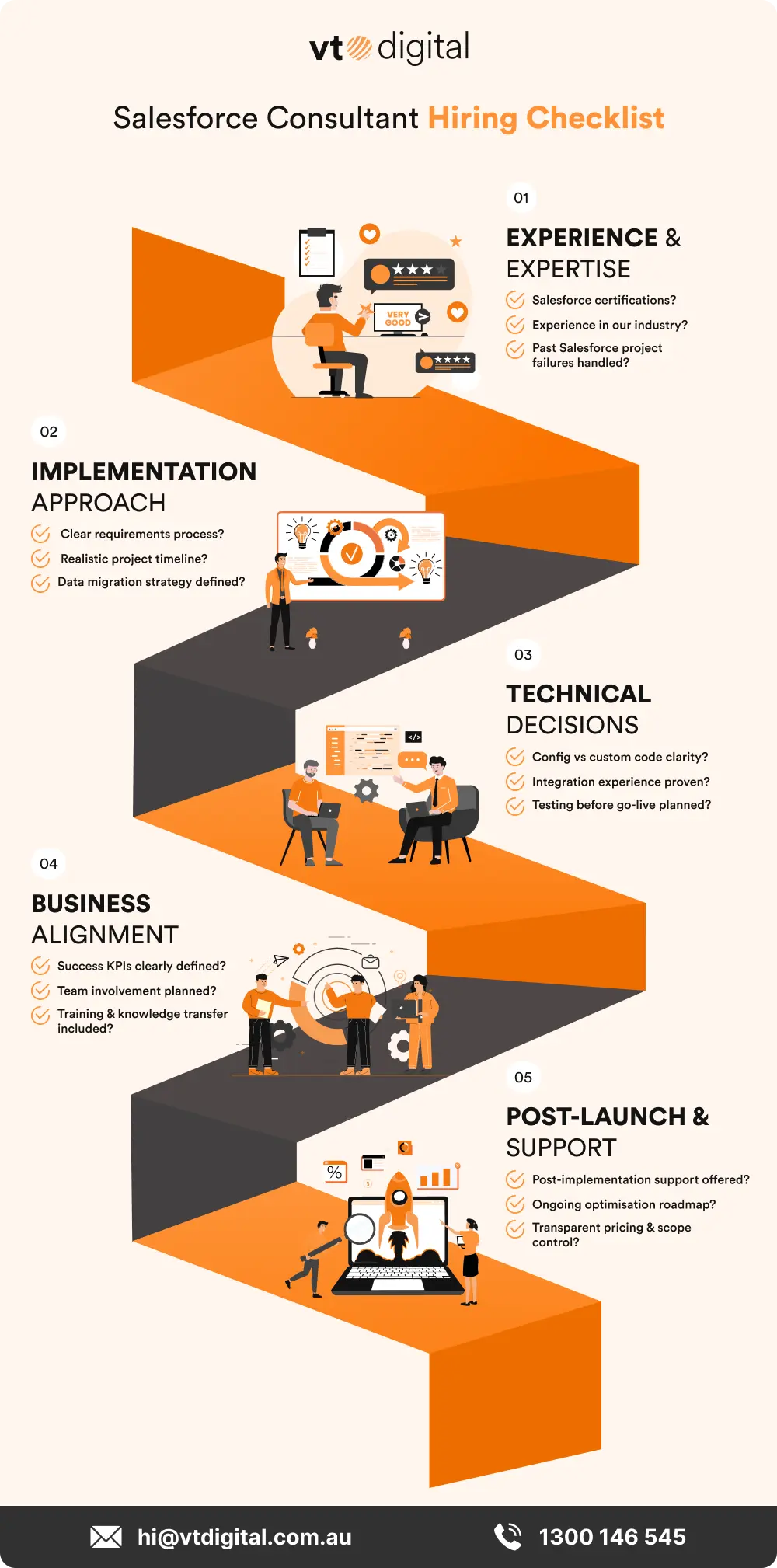
This guide gives you 15 Salesforce consultant hiring questions that show you exactly who you’re dealing with. These come straight from what Australian ecommerce brands, marketing teams, and tech companies ask when they’re vetting consultants.
Understanding Their Salesforce Expertise
1. What Salesforce certifications do you currently hold?
Certifications aren’t all equal. Salesforce Certified Administrator is entry-level stuff. Application Architect or System Architect? Now you’re looking at someone who can handle complex builds.
You want certifications that match what you’re doing. Running ecommerce? Commerce Cloud certifications matter. Marketing automation? Marketing Cloud credentials beat Sales Cloud expertise every time.
2. How long have you worked with businesses like ours?
Industry experience is everything. Someone who’s worked with Australian fashion retailers gets seasonal inventory spikes and return workflows. A generalist doesn’t.
Ask for actual client names in your sector. Good consultants share anonymised case studies with real numbers. Mecca Brands cut their sales cycle by 43% after restructuring opportunity management around beauty retail patterns, not generic templates.
3. Tell me about a project that went wrong and how you fixed it
This tells you more than any success story. Perfect track records? They’re either lying or they haven’t done enough projects. Complex Salesforce builds always hit problems.
Listen for ownership and problem-solving. Strong answer: “We integrated with a legacy inventory system with undocumented formatting. Three days before launch, product codes didn’t match. We built a translation layer using Flow Builder and set up temporary manual reconciliation while testing the automated fix.”
4. How do you learn about our current tech stack before suggesting solutions?
Your Salesforce setup has to work with your ecommerce platform, email tools, inventory system, and accounting software.
One salesforce consulting services provider in Melbourne saved a client $68,000 by spotting that their existing middleware could handle Salesforce integration. No custom connector needed.
Evaluating Their Implementation Process
5. How do you gather requirements for new projects?
This separates consultants who build what you need from those who build what they assume you need. Strong consultants run structured sessions with specific stakeholders, not just whoever shows up to kickoff.
A Melbourne retailer thought they needed “simple contact management.” Their Salesforce consultant in Sydney discovered they actually needed custom objects for loyalty programmes, B2B hierarchies, and franchise tracking. Week one, not month three.
6. What’s your typical timeline from discovery to launch?
Realistic timelines show experience. Basic Sales Cloud for 20 people takes 8-12 weeks. Commerce Cloud for an established ecommerce brand with 50,000 products needs 4-6 months minimum.
“We’ll have you running in three weeks”? They either don’t understand scope or plan to deliver something barely functional. Complex migrations and integrations take time to build properly.
7. How do you handle data migration from existing systems?
Data migration failures kill Salesforce projects. Duplicate customer records, missing order details, wrong contact links, chaos that takes months to fix.
Quality consultants start with data audits. They check your database for duplicates, incomplete records, formatting problems. They build transformation rules, run test migrations, validate results with your team.
8. What happens when we need changes after agreeing on scope?
Scope changes happen on every major project. Your business evolves, new needs pop up, initial assumptions prove wrong.
Professional consultants use formal change processes. They document requested changes, estimate time and cost impact, get approval before proceeding. They don’t just add features and surprise you with delays.
“We’re flexible, we’ll figure it out”? That ends in billing disputes.
Assessing Technical Capabilities
9. When do you use custom code versus standard configuration?
This tests technical judgment. Salesforce’s built-in tools handle most business logic without code. Consultants who jump straight to Apex either lack platform knowledge or want to inflate costs.
A Sydney ecommerce company nearly paid $35,000 for custom code to calculate shipping. Different salesforce consulting services provider built the same logic using Flow Builder in three days. Fraction of the cost.
10. How do you keep our Salesforce instance maintainable long-term?
Technical debt builds fast in poorly designed systems. Overly complex workflows, undocumented code, quick fixes, you end up with systems you can’t modify without breaking things.
Ask about documentation standards. You should get technical docs, user guides, training materials that make sense to someone who wasn’t part of the build.
11. What’s your testing approach before launch?
Thorough testing prevents launch disasters. User acceptance testing should involve actual team members doing real tasks in a sandbox. Normal workflows, edge cases, failure scenarios.
One Australian B2B manufacturer found during testing that quote generation took 47 seconds with real catalogues. Unusable. Their consultant optimised queries and got it down to 3 seconds before launch.
Understanding Business Alignment
12. How do you measure success for projects like this?
Consultants who can’t name specific metrics don’t understand business outcomes. “User adoption” sounds nice but tells you nothing concrete.
Examples of strong answer included are measurable KPIs linked to your goals. Ecommerce: 25% reduction of cart abandonment, 15% increase of order value, 40% increase in speed. Sales teams: 30% reduced cycles, 20% improved forecast accuracy
13. What role does our team play during implementation?
Successful implementations need significant client involvement. Your team participates in requirements sessions, reviews designs, tests configurations, validates data migration.
“We’ll handle everything, just sign off at the end”? They’ll create systems that don’t match how your team works. Your people know the business processes and edge cases no external consultant can discover alone.
14. How do you handle training and knowledge transfer?
A perfectly built system becomes worthless if your team can’t use it. Training needs to be role-specific, hands-on, ongoing.
Quality consultants deliver live sessions for different groups, provide recorded videos, offer documentation that makes sense. They include train-the-trainer sessions so you can onboard new employees without consultant fees.
15. What does post-implementation support look like?
Implementations don’t end at launch. You’ll find optimisation opportunities, need adjustments, want to add capabilities as your team gets comfortable.
Some consultants include 30-60 days of post-launch support in their quote. Others charge separately. Either works, but you need clarity before signing.
Making the Final Decision
The right consultant transforms your operations. The wrong one creates expensive problems that take years to fix.
Use these questions to distinguish the true pros from shortsighted salesmen. Australian businesses have success with Salesforce when they work together with consultants who have a proper understanding of local market conditions and understand how to navigate Australian privacy regulations. Your Salesforce consultant cost in Australia varies based on experience, certifications, and project complexity. The cheapest option rarely delivers the best results.
🎧 How Australian Businesses Choose the Right Salesforce Consultant

Australian businesses lose over $100,000 on failed CRM projects by hiring the wrong Salesforce consultant.
In this episode, we break down 15 must-ask Salesforce consultant hiring questions to help you spot real expertise.
If you’re comparing Salesforce consulting services in Australia or Sydney, this checklist can save you months of rework.
Put These Hiring Questions Into Action

Choosing the right consultant isn’t about finding somebody who can configure the platform. It’s about partnering with an expert that understands your challenges, and developing systems that scale with your growth.
Work with a Salesforce consulting partner, such as VT Digital. VT Digital has helped numerous SMBs and enterprise organisations across Australia build powerful, user-friendly Salesforce solutions that drive real outcomes.