Here’s the reality: Australian businesses can’t afford to wait six months for a developer anymore. The hiring market’s brutal. Development costs? Through the roof. And customers expect digital products to just work—whether that’s a health clinic, a law firm, or a retail chain.
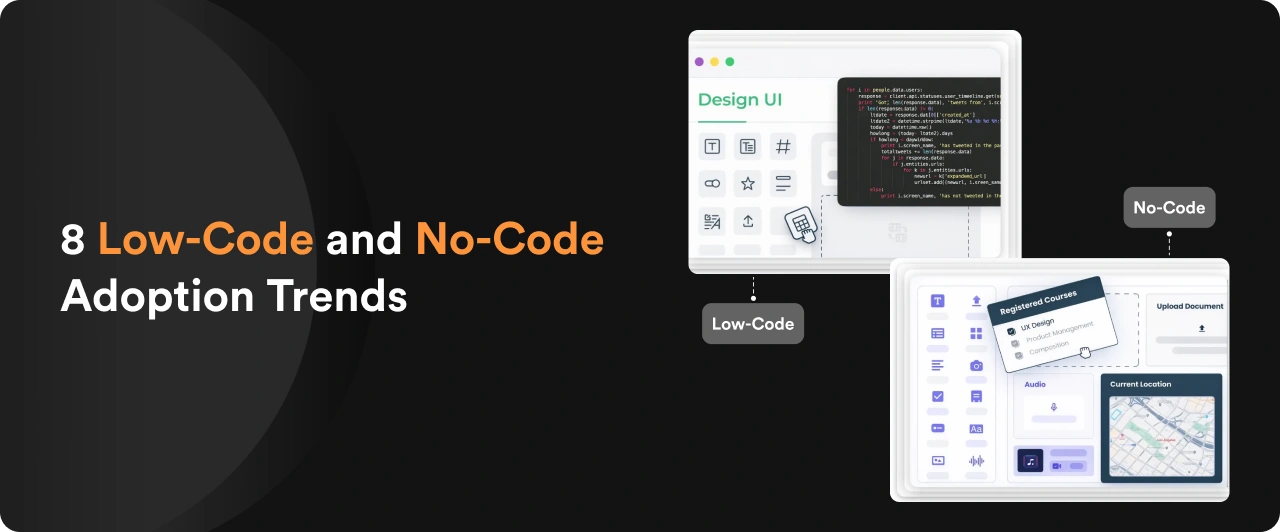
Enter low-code platforms and no-code development. These technologies have now matured into legitimate business tools that. Many Aussie companies actually rely on it for critical operations. What began as experiments in automation has turned into how organisations build, test, and launch products.
Here are the eight trends shaping how Australian businesses are adopting these tools in 2026.
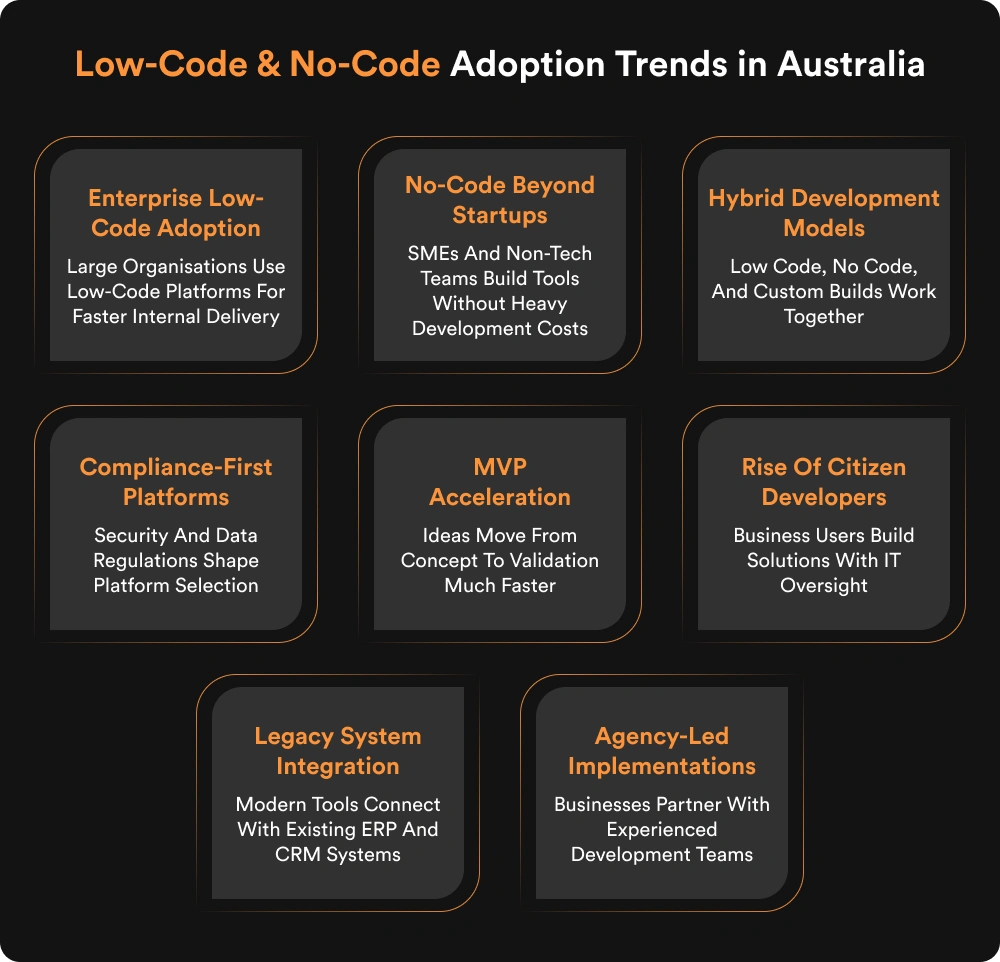
8 Low-Code and No-Code Adoption Trends in Australia for 2026
1. Low-Code Becomes a Core Enterprise Strategy
Walk into any major Australian organisation today, and you’ll find low-code platforms running internal systems, dashboards, and workflow automation, as actual infrastructure.
Most enterprises are still working with a software development company in Sydney for the heavy lifting: architecture decisions, scaling strategies, and governance frameworks. Low code speeds things up. Experienced developers keep things from falling apart.
2. No-Code Adoption Expands Beyond Startups
Remember when no code development was just for founders building MVPs in their spare bedroom? Not anymore. SMEs use it. Marketing agencies use it. Even corporate teams that wouldn’t know JavaScript from Java are building functional tools.
Marketing launches campaign microsites without IT tickets. Operations automates expense approvals. Product teams test concepts before writing a single line of custom code. The technology finally caught up to the promise.
3. Hybrid Development Models Take Over
The whole “low code vs no code” debate? Increasingly irrelevant. Australian businesses have figured out they can use both—and probably should.
No-code handles the simple stuff: internal forms, basic automations, quick prototypes. Low-code tackles customer-facing apps that need more flexibility. Custom code steps in when performance actually matters, like high-frequency trading platforms or real-time data processing. Pick the right tool for each job. Radical concept, apparently.
4. Compliance-First Low-Code Adoption
Finance, healthcare, and education sectors are choosing low-code platforms that tick every box:
- Australian data sovereignty,
- role-based access controls,
- seamless integration with existing enterprise systems.
Speed matters, sure. But not if it creates an OAIC audit nightmare six months later. This is precisely why throwing tools at problems without expert guidance usually backfires.
5. Low-Code Accelerates MVP and Product Validation
Building an MVP used to mean burning through cash for months before learning if anyone actually wanted your product. A bit inefficient. Low-code tools have compressed that timeline dramatically.
Test the business idea in weeks. Spend less upfront. Get real user feedback faster. Iterate without rewriting everything. Australian startups and innovation teams inside larger companies have figured this out: the faster you learn what doesn’t work, the faster you find what does.
6. Citizen Developers Become More Common
Non-technical staff building software. Sounds terrifying, right? Except it’s happening everywhere, and when done properly, it works. These “citizen developers” are solving problems in their departments because they understand the workflows better than anyone else.
Smart IT teams have stopped fighting this trend. Instead, they’ve set up guardrails: approved platforms, security standards, and review processes. Enable people without creating mayhem. It’s possible.
7. Integration with Legacy Systems Drives Adoption
Most Australian companies aren’t startups. They’ve accumulated systems over decades: ERPs, CRMs, custom databases that somehow still run critical operations. Replacing everything isn’t realistic (or smart).
Low-code platforms bridge these gaps through APIs and pre-built connectors. Modernise gradually instead of attempting massive, risky overhauls that inevitably go over budget and past deadline. The old systems keep working. The new tools make them better. Everyone stays employed.
8. Strategic Partnerships with Development Agencies Increase
As more businesses adopt these tools, they’re realising that platform selection actually matters. A lot.
Wrong choice upfront? Expensive migration later. Poor architecture? Scaling becomes impossible.
That’s why partnerships with experienced development teams are growing. They handle platform evaluation, architecture planning, and long-term scalability—while internal teams move fast on execution.
A software development company in Sydney provides that strategic layer without slowing down delivery.
Low-Code & No-Code Adoption Trends in Australia (2026)
Low Code vs No Code: What Australian Businesses Need to Know?
The practical answer: use both strategically. No code development excels at straightforward automation, internal tools, and rapid prototyping. Anyone can use it. That’s the point. Low-code platforms offer more potential for complex logic and custom integrations.
Most businesses don’t need to plant a flag on one side. Use no code where you just need simplicity. Reach for low code when you need more control. Match the tool to the problem, not the other way around.
🎙️ Building Smarter Apps with Low-Code and No-Code

Forget the hype and debates.
This episode looks at how businesses are mixing no-code, low-code, and custom development to solve real problems and move faster in 2026.
Turn Speed Into a Real Business Advantage

Thinking about low code for your organisation? Start by identifying your biggest development bottlenecks and compliance requirements. Chatting with a software development company in Sydney before committing to platforms prevents expensive mistakes down the track.
Frequently Asked Questions (FAQs)
Three big things are happening right now. First, enterprises aren’t treating these no-code and low-code platforms as core infrastructure. Second, the hybrid approach has won. Companies mix no-code for simple tasks and low-code for complex apps. Another trend is that Australian businesses in regulated industries prefer platforms that can handle local data compliance.
Australian businesses are quickly integrating globally popular low-code platforms, Microsoft Power Apps, Salesforce, and Appian. Other platforms becoming popular include OutSystems and Mendix.
With No-code platforms, users can build apps using visual tools like drag-and-drop. No need to write code. These platforms are ideal for simple tasks. Low-code platforms offer similar visual tools but allow for custom code. A low-code platform offers proper infrastructure for more complex, scalable, and enterprise-grade solutions.