Budget planning in a spreadsheet? Gorgeous. Everything lines up. The formulas work. You feel like you’ve got it sorted. Then the real-world scenarios show up.
Digital marketing costs don’t sit still. A digital marketing budget plan works properly when you focus on three things. Clarity on what you’re trying to do. Room for flexibility when market changes. A structure that makes sense when your stakeholders ask questions.
Here’s how to build one that actually works. Many companies hire a digital marketing agency. These experts help them create a well-planned budget according to the available marketing funds.
Step 1: Start With What You Want to Achieve
Everyone wants to jump straight to the fun stuff, like LinkedIn ads or influencer partnerships.
Stop. What’s marketing supposed to deliver this year? Like, actually deliver?
More qualified enquiries? Direct sales through the website? These are the goals for established businesses. Launching in Melbourne this year? Your focus should be on brand awareness. Each of these needs a completely different approach, which means a completely different budget.
Step 2: Be Honest About Where the Business Is Right Now
If you’re still building awareness, you’ll mostly need to spend more initially. It’s expensive when nobody knows you exist. Already established with steady sales? The focus usually shifts to efficiency and optimisation. This context shapes how much to spend on digital marketing more than any industry benchmark.
Step 3: Use Revenue Percentages as a Reality Check
Here’s a rough guide most Australian businesses work within:
- Around 5–8% of revenue for steady growth
- Closer to 8–12% when pushing hard or launching something new
These aren’t commandments. They’re guardrails. If you’re at 2%, ask why. If you’re at 18%, also ask why. You might have brilliant reasons. Or you might be haemorrhaging cash on marketing plans that don’t work for your business model.
Step 4: Split the Budget Into Clear Buckets
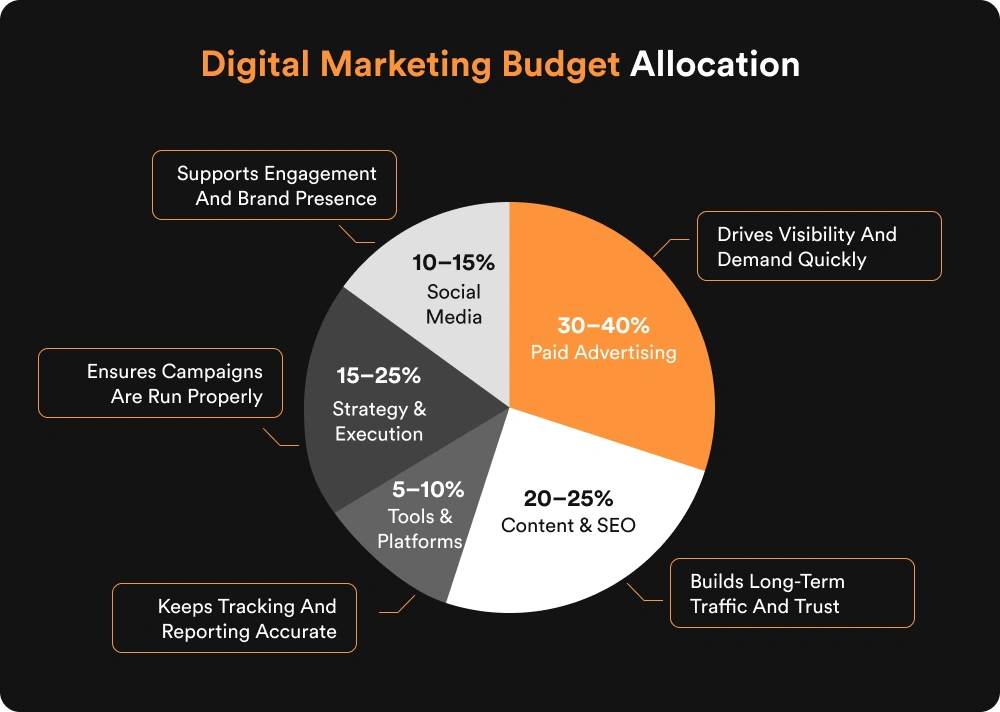
One line item that just says “marketing spend”? Useless. You need to break your digital marketing budget plan into sub-sections:
- Paid media (Google, Meta, LinkedIn)
- Content and SEO
- Social media (organic and paid)
- Tools and platforms (because Canva subscriptions add up faster than you think)
- Strategy and execution (whether that’s in-house salaries or agency fees)
Once you’ve separated this stuff, it becomes obvious what’s delivering and what’s just there. Existing. Costing you money.
Step 5: Spend Where Your Customers Actually Are
Every business is different. Some absolutely dominate on Google because that’s where their customers start researching.
Most B2B businesses market on LinkedIn because that’s where professional conversations happen. The right mix depends entirely on where your customers shop, research, and make decisions.
Digital marketing experts in Sydney add the most value in this phase. They help businesses avoid spreading spending too thin.
Step 6: Expect Costs to Rise (Because They Will)
Digital marketing gets more expensive every year.
More businesses are competing for the same ad space. Platforms change their algorithms because they want more money. That creative you made six months ago stops working, and you need to refresh it.
When you’re planning your budget, assume costs will increase by at least 10–15% and build that in. Otherwise, you’ll hit September and suddenly can’t afford to keep campaigns running at the same level.
Step 7: Keep a Portion of the Budget Flexible
Locking down every single dollar upfront feels responsible. It’s not. Set aside 15–25% for testing. New audiences you want to try.
A format you’ve never used before. That channel your competitor seems to be smashing. Some of it will fail spectacularly. That’s fine. Some of it will outperform everything else you’re doing by 3x, and that’s where the growth comes from.
Step 8: Decide What You’ll Do In-House—and What You Won’t
Be realistic about what your team can actually handle. Maybe you have the right resources to handle content internally. And you can hire/consult a digital marketing agency for paid campaigns or strategy.
Some companies outsource everything to stay focused on core operations. Your budget should reflect real capacity. So plan your hiring accordingly. Human resources are as important as your tools and platforms.
Step 9: Track Outcomes, Not Just Activity
Impressions look impressive in a monthly report. So do clicks. Know what’s more impressive? Revenue.
Track leads. Conversions. Customer acquisition cost. Actual sales. You might be marketing on a channel that’s getting loads of traffic, but nobody’s buying anything. It doesn’t deserve the same budget as the one that’s quietly bringing in customers every week.
Many businesses keep pouring money into channels just because the numbers look big. But in the end, they go over-budget without any real outcomes.
Step 10: Revisit the Budget More Than Once a Year
Markets change. Your best-performing campaign suddenly stops working. A competitor launches something that shifts the whole landscape. Priorities change because, I don’t know, there’s a global pandemic or interest rates go mental.
Review your budget monthly. For the best outcomes, you need to adjust it quarterly. The businesses doing well aren’t the ones with the big budgets. They’re the ones that adapt when reality changes.
Digital Marketing Budget Allocation
🎙️ How Much Should You Really Spend on Digital Marketing?

From revenue percentages to channel splits, budgeting can feel overwhelming.
This episode simplifies digital marketing budget planning so businesses can spend smarter, adapt faster, and avoid wasted ad dollars.
Final Thought

A decent digital marketing budget plan is about spending smarter. At VT Digital, we work with Australian businesses to plan and optimise digital spend without the guesswork or wasted money. When you see actual results, your digital marketing spend will stand out like a good business investment rather than a risky gamble.
Frequently Asked Questions (FAQs)
Most Australian businesses sit between 5% and 12% of annual revenue. Where you land depends on whether you’re growing aggressively, how competitive your industry is, and where you are in your business lifecycle.
Start with your marketing goal. It can be more than one and varies based on your company’s growth stage. Then split your budget across paid media, content/SEO, social, tools, and execution. Adjust based on what’s actually performing.
It varies massively depending on industry and goals, but expect ongoing costs to increase year-on-year. Competition keeps growing, and platforms keep getting more expensive.
Focus on flexibility over perfection. Allocate funds into channels that are showing real results. Keep some budget for testing new things. Review performance regularly so you’re not wasting money on activities that don’t work.