Introduction
Mobile apps aren’t optional anymore for Australian businesses. But picking the wrong framework can cost you months and thousands of dollars. The right one? It makes development faster, cheaper, and way less stressful down the line.
Flutter and React Native keep coming up in every conversation about app development in Australia. They’re the most popular frameworks in the market. Both work. Both have massive communities behind them.
Australian companies care about specific things. Can we launch quickly? Will we find developers easily? Does it perform well enough? Can it talk to device hardware when needed? Your answer to these questions points you toward one framework or the other.
What Are Flutter and React Native?
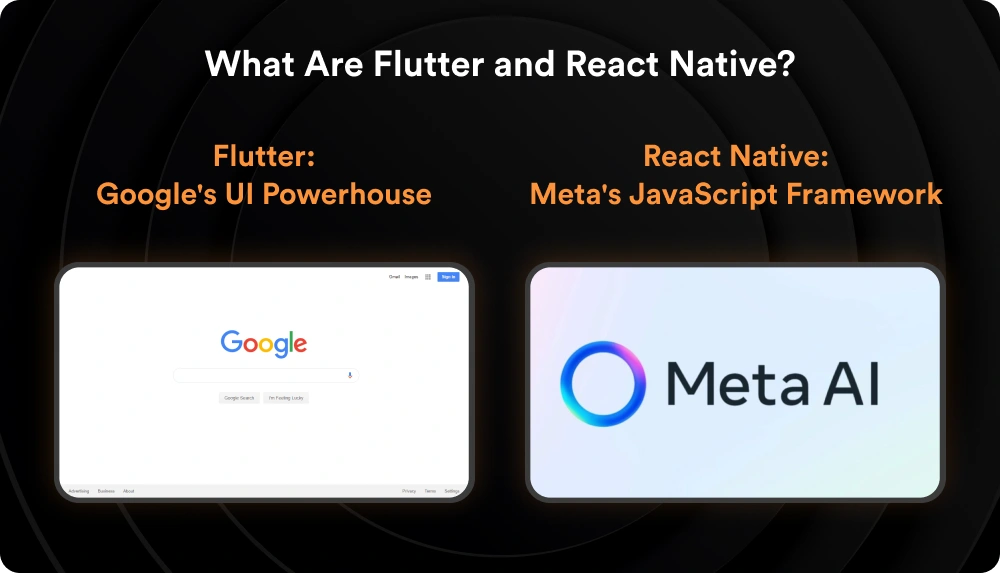
Flutter: Google’s UI Powerhouse
Flutter comes from Google. It uses a language called Dart. Not as common as JavaScript, but powerful for what it does.
The framework compiles directly to native code. This means smoother performance. It also means pixel-perfect designs that look identical on iOS and Android. Many Australian businesses hire a Flutter app development company specifically for complex UI work.
React Native: Meta’s JavaScript Framework
React Native was built by Meta (formerly Facebook). It leverages JavaScript and React. Millions of developers already know these technologies.
The ecosystem is massive. Pre-built components are everywhere. Teams familiar with web development can jump straight in.
This is why React and native solutions are so popular. Companies use React Native software framework to move fast without reinventing the wheel.
Performance: Which Framework Runs Smoother?
Flutter compiles to native ARM code. No bridge is slowing things down. It uses the Skia rendering engine—the same technology behind Chrome. Animation-heavy apps? Flutter handles them beautifully. Smooth scrolling, fluid transitions, zero lag. Think consumer apps with rich visuals and constant motion.
React Native takes a different approach. It uses a JavaScript bridge to communicate with native components. This works well for most apps. But heavy graphics or intense animations? The bridge can become a bottleneck. The new architecture improves things significantly. Still, it doesn’t quite match Flutter’s raw speed.
Bottom line: For graphics-intensive apps, Flutter wins. For standard business apps, React Native performs just fine.
Speed to Market: Building Your MVP Fast

Flutter offers Hot Reload. Change your code, see results instantly. No full recompile. Development moves quickly. But there’s a catch. Your team needs to learn Dart. Not impossible, but it adds time upfront. If nobody knows Dart, expect a learning curve.
React Native plays to existing strengths. JavaScript developers are everywhere. TypeScript skills transfer directly. The ecosystem is packed with ready-made solutions. Need a prototype in weeks? React Native delivers. Especially if your team already codes in JS/TS.
The verdict: React Native gets MVPs out the door faster—if JavaScript is already in your tech stack.
Native Integrations: Going Deep with Hardware
Some apps need deep access to device hardware. Bluetooth Low Energy sensors. Custom SDKs. Camera controls. Biometric authentication.
Flutter handles this through platform channels. The approach is clean and well-documented. Hardware integrations are stable and predictable. Building a health app that connects to wearables? Flutter makes sense. Working with IoT devices? Same story.
React Native supports native modules too. The community has built plugins for almost everything. But quality varies wildly. Some packages are maintained religiously. Others haven’t been updated in years. You might find yourself writing native code or fixing broken dependencies.
The takeaway: Flutter is more reliable for apps that live close to the hardware layer.
Cost Comparison: Hiring Developers in Australia
Flutter developers are growing in number. The community in Australia is active and enthusiastic. But it’s still smaller compared to JavaScript. Experienced developers are out there. Fees of a specialist Flutter app development company can run higher due to scarcity.
JavaScript developers are everywhere. This makes React Native hiring significantly easier. Cost-effective too. Onboarding is simpler. Most developers already know React. Training becomes minimal.
What this means: React Native wins on hiring availability and cost across Australia.
Building Custom UIs: How quickly can developers bring designs to life?
Flutter gives pixel-level control. Every shadow, every gradient, every animation—exactly as designed. Design-centric apps thrive here. The output looks identical on all devices.
React Native excels with standard components. Pre-built UI elements ship fast. Great for business apps with conventional interfaces. Highly custom designs? You’ll hit limitations.
For polished, custom experiences: Flutter provides better developer productivity.
Testing and Debugging Tools
Flutter ships with integrated testing. Unit tests, widget tests, integration tests—all built in. DevTools are powerful and well-maintained. Profiling performance is straightforward.
Everything lives in one ecosystem. Less configuration headache. More actual testing.
React Native relies on external tools. Jest for unit testing. Detox for end-to-end. Third-party libraries for everything else. It works. But consistency varies. Debugging bridge issues adds complexity. Different projects might use completely different tooling stacks.
The difference: Flutter offers a more cohesive testing and debugging experience.

Side-by-Side Comparison
Criteria | Flutter | React Native |
Performance | Excellent—native ARM compilation plus Skia rendering | Good—JavaScript bridge can bottleneck heavy apps |
MVP Speed | Fast, but requires a learning curve for Dart. | Fastest when the team knows JS/TS |
Native Integrations | Very strong and stable via platform channels | Good, but plugin quality is inconsistent. |
Hiring in Australia | Growing pool, but smaller and specialised | Large JavaScript talent pool, easier hiring |
UI Customisation | Best for complex, pixel-perfect designs | Good for standard components |
Testing & Tooling | Unified, robust, built-in framework | Diverse but fragmented across tools |
Which Framework Should Australian Businesses Choose?
Choose Flutter when:
- Your app is design-heavy with custom animations
- Performance can’t be compromised
- Deep hardware integration is required
- Visual consistency across platforms is non-negotiable
Choose React Native when:
- Your team already works in JavaScript/TypeScript
- Speed to market is the top priority
- Hiring and scaling developers matter
- Standard UI components meet your needs
🎧 Podcast: Flutter vs React Native for Aussie Apps 2025

A deep dive into how Flutter and React Native compare for Australian businesses, from performance and UI to hiring, integrations, and MVP speed. Clear guidance on choosing the best framework for your next mobile app.
🎙 Press play and avoid costly mistakes.
Frequently Asked Questions (FAQs)
Flutter wins here. It compiles straight to native ARM code—no middleman slowing things down. The Skia rendering engine handles animations beautifully. React Native uses a JavaScript bridge that can create hiccups in graphics-heavy apps.
React Native, hands down. Your team already knows JavaScript, so they can start building today. The ecosystem is huge—most features already have packages built for them. You’ll go from idea to working prototype faster than with any other option.
Flutter handles this stuff better. Platform channels give you clean access to device hardware without the drama. React Native can do it, but you’ll spend more time hunting for good plugins and fixing compatibility issues.
React Native makes hiring way easier. JavaScript developers are everywhere in Australia. You’ll get more applications, pay less, and onboard people faster.
Flutter. When designers want something specific, Flutter delivers it exactly. Pixel-perfect control. Same look on every device. React Native works great for standard UI components.
Flutter keeps everything in one place. Unit tests, widget tests, integration tests—all built in. React Native makes you connect different tools. It works, but debugging bridge issues in production may turn complex.