Adapting to the New Era of Software: The DevOps Way
Software moves differently now. Updates happen weekly. Sometimes daily. Customers don’t wait around anymore. Traditional IT? It’s too slow. Approval processes that drag on for weeks kill momentum. Manual deployments every quarter mean falling behind competitors who ship constantly.
A DevOps consulting company changes this. They automate what’s broken. Get teams actually collaborating. Turn chaotic releases into smooth operations. Businesses adapt or get left behind. Simple as that.
The Enterprise Case for DevOps Consulting
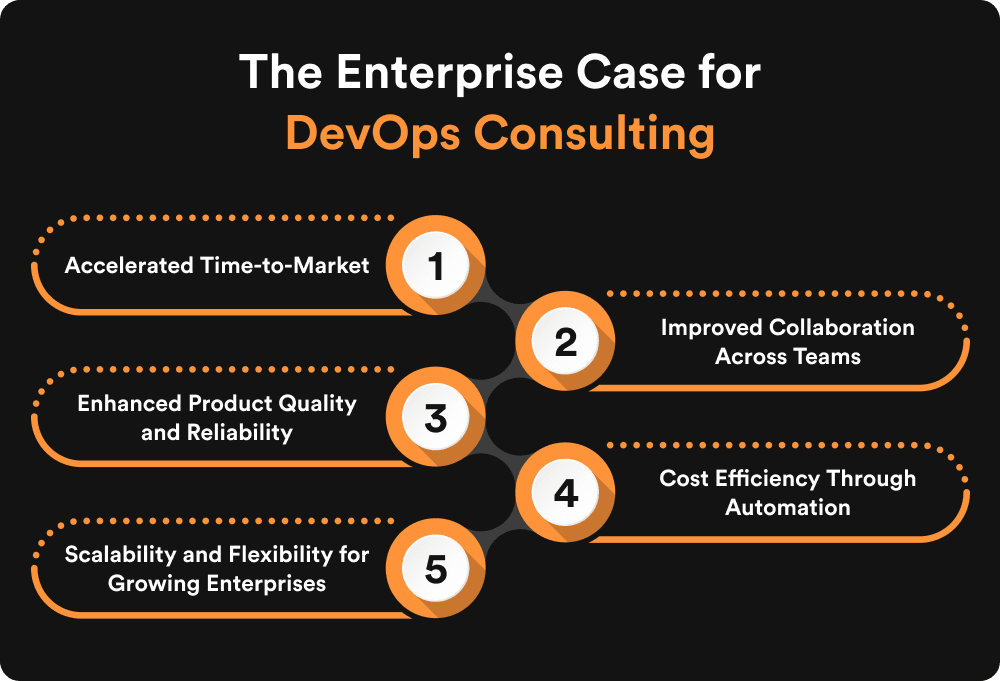
1. Accelerated Time-to-Market
Planning releases used to eat up months. Testing took weeks. Deployments happened on weekends because everyone expected disasters.
DevOps consultants flip this around. Code moves from laptop to production in hours. Tests run themselves. Bug discovered Monday morning? Live fix by Tuesday lunch. New feature needed for a campaign? Ready a week early. That’s how companies stay ahead.
2. Improved Collaboration Across Teams
Here’s the typical setup. Developers build features. Operations handles servers. Neither really gets what the other does daily. QA sits between them, trying not to get crushed.
DevOps consulting services tear this down. Everyone uses shared dashboards. Sees the same metrics. Owns problems together. Automated tools keep people synchronized instead of playing phone tag. The finger-pointing stops. Work actually gets done.
3. Enhanced Product Quality and Reliability
Production bugs cost real money. They tank customer trust fast. One bad deployment can wreck months of good work.
Continuous testing spots issues before launch. Monitoring catches problems sometimes before customers even notice. Teams fix things immediately because alerts include actual useful information.
4. Cost Efficiency Through Automation
Manual work wastes both time and budget. Someone provisions servers by hand. Another person runs test suites manually. Someone else stares at monitoring dashboards all day.
Why? Machines handle this better.
DevOps consultants automate what makes sense. Infrastructure appears when needed. Tests run on every commit. Monitoring happens 24/7 without humans watching screens. Cloud bills often drop 30-50% from cutting waste and right-sizing resources. Same performance, less money.
5. Scalability and Flexibility for Growing Enterprises
Growth breaks things. Traffic spikes crash websites. New market launches overwhelm systems. Success turns into a technical nightmare.
Good DevOps stops this. Infrastructure scales automatically. Adding new regions doesn’t require all-hands panic mode. Systems grow alongside the business.
Black Friday traffic? Handled. Viral campaign? No crashes. Three new countries next quarter? Infrastructure’s ready.
Core DevOps Services That Transform Enterprise Operations
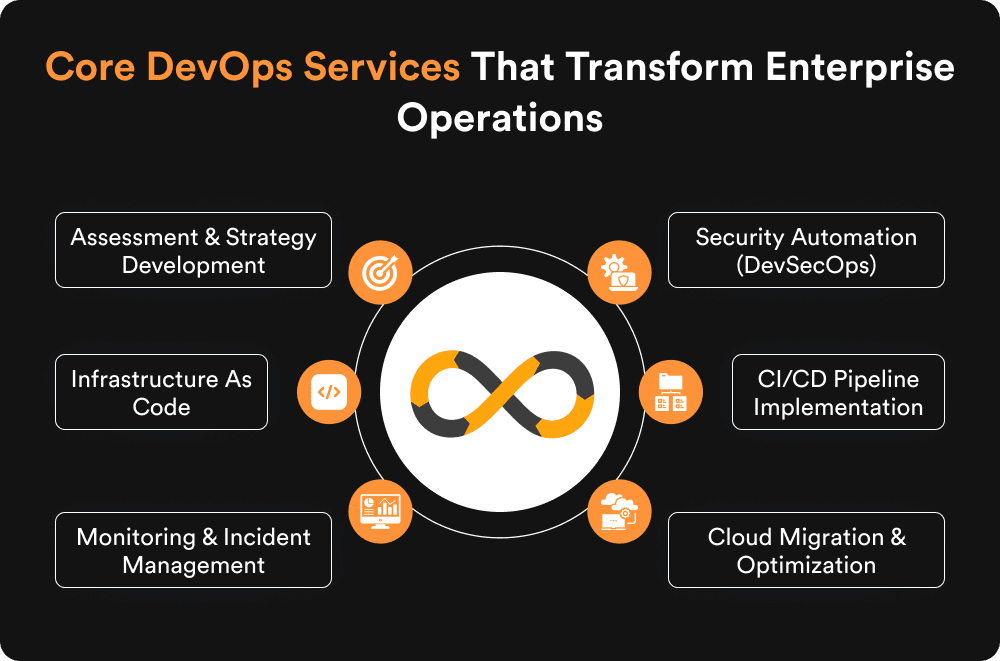
- Assessment & Strategy Development: Consultants look at actual workflows and find real bottlenecks. Not guesses. They build specific plans for specific businesses.
- CI/CD Pipeline Implementation: Code gets tested and shipped automatically. No manual steps. No weekend work. Releases become routine instead of events.
- Infrastructure as Code: Tools like Terraform turn servers into versioned code. Every environment matches perfectly. “It worked in dev” stops being a thing.
- Cloud Migration & Optimization: Moving to AWS, Azure, or GCP safely. No horror stories. Security stays tight. Performance goes up. Bills stay reasonable.
- Monitoring & Incident Management: Real monitoring that helps. Problems get detected early. Alerts go to people who can fix them, with context that matters.
- Security Automation (DevSecOps): Security at every step, not tacked on later. Compliance checks run automatically. Vulnerabilities caught during development, not in production.
DevOps Service | What It Involves | Key Business Benefit |
Continuous Integration (CI) | Automating code testing and merging | Improves code quality and reduces bugs |
Continuous Delivery (CD) | Streamlining deployment pipelines | Speeds up feature releases |
Infrastructure as Code (IaC) | Managing infrastructure via code | Enhances scalability and repeatability |
Monitoring & Logging | Tracking performance in real-time | Enables proactive issue resolution |
Containerization (Docker/Kubernetes) | Packaging apps for consistency | Boosts portability and reliability |
Cloud Migration | Moving workloads to the cloud | Reduces infrastructure costs |
Security Automation (DevSecOps) | Integrating security at every stage | Strengthens data protection |
Performance Optimization | Fine-tuning resource utilization | Improves system efficiency |
Choosing the Right DevOps Consulting Partner
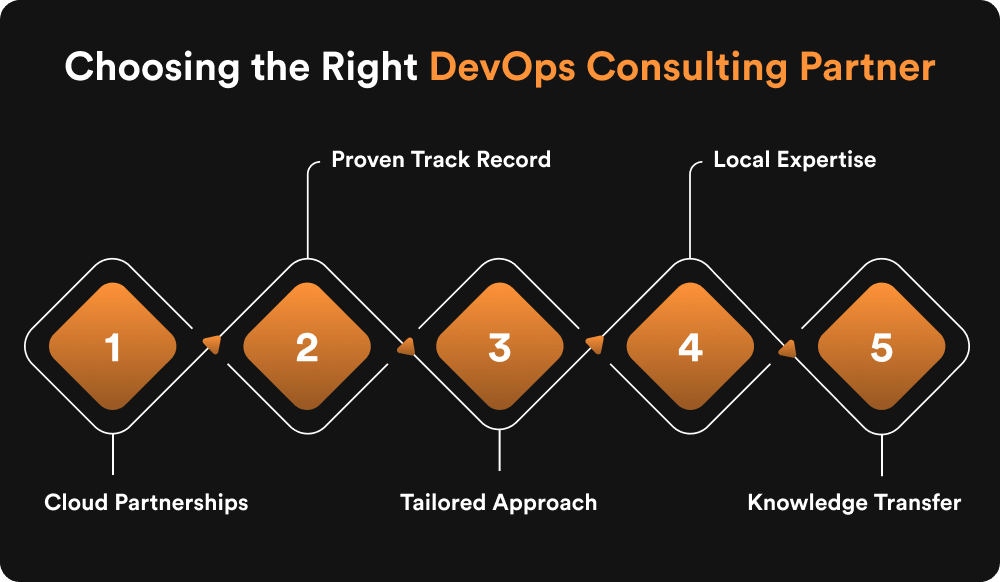
Proven Track Record
Case studies from similar companies offer valuable insights into the consultant’s working style. Real references help. Specific numbers beat vague promises.
Cloud Partnerships
AWS, Azure, GCP partnerships mean deep expertise. Partners access resources that generic consultants can’t.
Tailored Approach
Generic solutions rarely work. Every business differs. DevOps implementation plans should reflect that.
Knowledge Transfer
Knowledge transfer is essential to remove barriers and for quick adaptation. Good consultants teach teams to run things alone. Building dependency is poor consulting.
Local Expertise
A DevOps consulting company in Australia knows local rules and works during compatible hours. Geography matters for compliance and communication.
🎧 Podcast: Listen: DevOps Consulting for Enterprise Speed Now

Hear how DevOps consulting speeds releases, automates testing, reduces cloud costs and boosts reliability.
Real tactics, service breakdowns and how to pick the right partner for Australian enterprises.
🎙 Listen in and make a confident decision for your next project.
Future-Proofing Enterprise IT with DevOps
A DevOps consulting company provides the expertise to compete in today’s fast-moving market. Faster deployments. Lower costs. Systems that handle actual demand.

Frequently Asked Questions (FAQs)
Building DevOps skills internally takes years. Consultants bring immediate expertise from dozens of implementations. They know what works because they’ve already failed and learned.
Skip the painful learning curve. Get results in weeks.
Obvious ones: faster releases, fewer outages, cheaper cloud bills. Real benefit: competitive edge. Deploy while others plan. Scale during spikes automatically.
Removes walls between teams. Everyone sees the same data. Problems get solved together, not blamed around. Automation handles boring, repetitive work.
Waste disappears. No waiting for approvals. No rebuilding environments constantly.
Digital transformation often fails in execution. Consultants connect strategy to reality. Assess honestly. Plan realistically. Implement while managing cultural shifts.
Tech changes without people adopting them achieve nothing.
DIY seems cheaper initially. Then mistakes pile up. Wrong tools get chosen. Momentum dies when people leave. Professional services deliver fast. Teams learn from experts, not blogs. Real cost is moving slowly while competitors sprint ahead.